
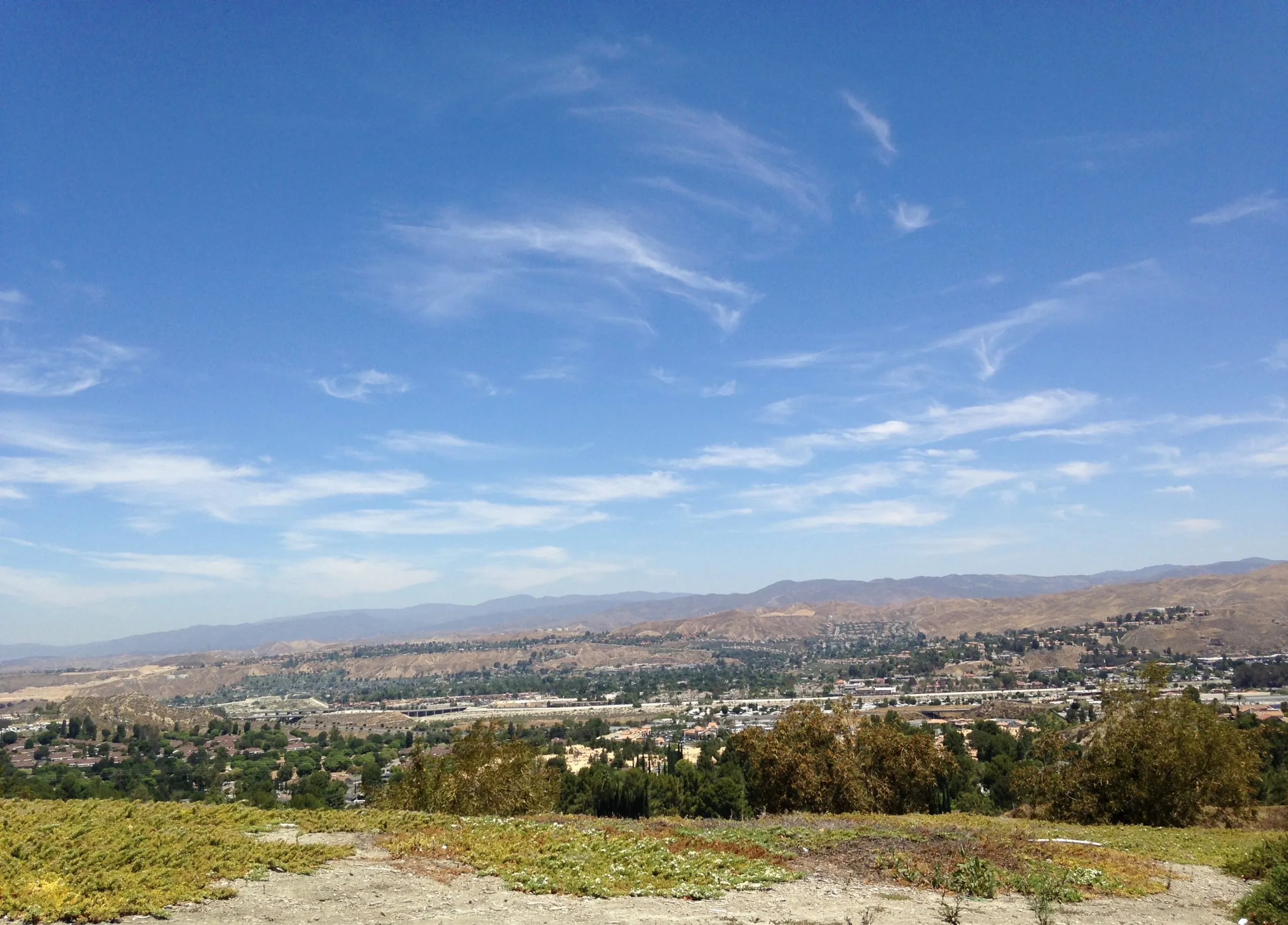
Towns across the valley
Plumbing by Kirk works from a shop in Valencia, inside the City of Santa Clarita, and takes calls across the Santa Clarita Valley: Santa Clarita itself, Valencia, Newhall, Saugus, Canyon Country, Stevenson Ranch and Castaic.
Those places share a valley but not one set of rules. Valencia, Newhall, Saugus and Canyon Country were the four communities in the new City of Santa Clarita in 1987, and each still takes in some county land. Stevenson Ranch and Castaic are unincorporated Los Angeles County. Here is what that means for a home in each.
| Place | City or county | Plumbing permits from | Water supplier | Miles from the shop |
|---|---|---|---|---|
| Santa Clarita (City Hall) | City of Santa Clarita | The city | SCV Water | 2.3 |
| Valencia | City and county; Valencia by FivePoint is county | The city, or the county by address | SCV Water | 3.1 |
| Newhall | City, with a county portion | The city, or the county by address | SCV Water | 4.9 |
| Saugus | City, with a county portion | The city, or the county by address | SCV Water | 2.9 |
| Canyon Country | City and county | The city, or the county by address | SCV Water | 7.3 |
| Stevenson Ranch | Unincorporated county | LA County Public Works | SCV Water | 5.3 |
| Castaic | Unincorporated county | LA County Public Works | SCV Water; LA County Waterworks District 36 in Hasley Canyon | 6.7 |
The miles are road distances from the shop to the point the US Geological Survey maps for each town, or to City Hall for Santa Clarita, by a routing estimate without traffic. They measure distance, not arrival time.
Who issues plumbing permits in the Santa Clarita Valley
The office that issues a plumbing permit follows the address: whether the lot sits inside a city’s limits, not which town name it goes by. Two offices cover the valley.
| Office | Covers | Where | How permits are issued | Fees for a water heater |
|---|---|---|---|---|
| City of Santa Clarita, Building and Safety | Addresses inside the city | Permit Center at City Hall, 23920 Valencia Boulevard, Suite 140 | Instant online permits for a residential water heater changeout, a repipe or a water service line | $38 to issue, $42 for the heater and $22 for the inspection: $102, plus the 10% record maintenance fee where it applies (schedule effective August 24, 2026) |
| LA County Public Works | Unincorporated areas: Stevenson Ranch, Castaic, Valencia by FivePoint and the county parts of the other towns | Santa Clarita Valley Building and Safety Office, 23757 Valencia Boulevard | Express permits, online only, for simple residential jobs such as a water heater replacement or a drain repair | $41.35 to issue and $24.47 for the heater and vent: $65.82 (fees effective July 1, 2026) |
To check an address, use the Residency Status Verification Tool on the city’s annexations page, or LA County’s online service locator, which shows whether a point is unincorporated and which county office covers it.
The city’s building code leaves the addition, alteration, replacement or relocation of water, sewer, drain and vent piping out of the ordinary repairs that need no permit, while it exempts swapping a faucet, sink, toilet or shower head for one of the same type. LA County requires a permit for any water heater installation or replacement. Kirk’s crew pulls the permit when the city or county requires one, from whichever office covers the address.
Salt-based softeners are banned in the valley
Automatic, self-regenerating salt-based water softeners are prohibited throughout the Santa Clarita Valley. The ban comes from the Los Angeles County Sanitation Districts, and as they describe it, the valley includes the City of Santa Clarita and the unincorporated communities around it, such as Stevenson Ranch, Castaic and Valencia by FivePoint. The ban on installing them took effect in 2003, and Measure S (2008) required existing home softeners that drained to the sewer to come out by June 30, 2009. It covers softeners that use rock salt, sodium chloride or potassium chloride.
The City of Santa Clarita also writes the ban into its own plumbing code: automatic or self-regenerating systems that use sodium chloride or potassium chloride are prohibited in the city, and so are softener systems that discharge into a dry well, unless the Building Official approves one whose discharge stays within the Regional Water Quality Control Board’s limits. The code makes an exception for portable exchange tanks installed and maintained commercially, as long as no brine goes into the public sewer, and permits salt-free water conditioning systems once the Sanitation Districts approve them.
The ban reached Valencia by FivePoint on October 1, 2026, when an ordinance of the Newhall Ranch Sanitation District took effect. Valencia has the details, including the buy-back for softeners installed there before that date.
Moving the brine somewhere else doesn’t get around it. The Sanitation Districts say that putting softener brine onto land or into a dry well is illegal, even with potassium chloride, and the Los Angeles Regional Water Quality Control Board won’t issue permits for either.
The reason is chloride. The valley’s wastewater is treated at the Valencia and Saugus water reclamation plants, and the Sanitation Districts had to build an advanced treatment facility at the Valencia plant, in operation from 2023, to take chloride out of wastewater before it is released into the Santa Clara River.
What the Sanitation Districts list as allowed: portable exchange tank softeners, salt-free water conditioning systems, and other treatment such as reverse osmosis and carbon filtration. They don’t endorse any product. Salt-free conditioners aim to cut scale, and the Water Quality Association notes that such anti-scale devices don’t reduce the total calcium or magnesium in the water and aren’t proven to produce soft water. Water softeners compares the allowed systems and what each does about scale.
City of Santa Clarita residents who still have a softener they own may be eligible for the Sanitation Districts’ free removal program; rented units aren’t eligible. Questions about the ban go to the Sanitation Districts at 1-877-CUT-SALT or cutsalt@lacsd.org.
How hard the water is, and the backflow rule
SCV Water is the valley’s regional water provider, formed on January 1, 2018, when the local water suppliers merged. Its 2026 water quality report, covering 2025, puts the hardness of its groundwater at 354 mg/L on average, in a range of 220 to 480, and of its imported surface water at 160 mg/L, with some of the surface water data from 2024. Converted at 17.1 mg/L per grain, that is about 20.7 and 9.4 grains per gallon. The US Geological Survey counts anything over 180 mg/L as very hard, and notes that hard water forms scale in water heaters and pipes.
What reaches a given tap depends on the mix. In 2025 about a third of SCV Water’s supply was groundwater and two thirds imported water, served in various proportions across its area, and the agency says the water can seem harder than usual in a drought, when it relies more on groundwater. Its report doesn’t break the mix down town by town.
Some addresses are on other systems. LA County Waterworks District 36, whose service area takes in the Hasley Canyon area, has SCV Water as its wholesale water provider, and the same report gives the district’s own hardness: 270 to 470 mg/L, 355 on average.
SCV Water also has a backflow rule. Where a property has a cross connection, the owner has to install and maintain a backflow prevention assembly and have it tested every year by a tester certified by the American Water Works Association, the American Society of Sanitary Engineering or the American Backflow Prevention Association, with passing results sent to backflow@scvwa.org. A missed test brings a fee of $200 for each month out of compliance, and after six months domestic water service is shut off. District 36 accepts testers certified by the LA County Department of Public Health.
Neighborhoods and the towns they belong to
Some addresses go by a neighborhood name. Here is which side of the city line each one sits on, and the town page that covers it.
| Neighborhood | City or county | Town page |
|---|---|---|
| Fair Oaks Ranch | City, annexed with West Sand Canyon on September 11, 2012 | Canyon Country |
| Sand Canyon | Split: city parts annexed in 2012, 2013 and 2018; the eastern portion is still county | Canyon Country |
| Plum Canyon and Skyline Ranch | City, both annexed on November 15, 2018 | Saugus |
| Tesoro del Valle | City, from November 14, 2022 | Valencia |
| Valencia by FivePoint, including Mission Village | County | Valencia |
| Westridge | County, part of West Ranch with Stevenson Ranch | Stevenson Ranch |
City or county decides which office issues the permit, so check a neighborhood address the same way as any other. To book a plumbing job in any of these towns, call the shop with the address.
Sources
10 cited
- City of Santa Clarita, city profile, annexation map and annexations (the 1987 communities, annexation dates, the address tool), read October 13, 2026
- LA County, Santa Clarita Valley Area Plan, Supervisor Barger, Fifth District areas and the LA County service locator (city and county land), read October 13, 2026
- City of Santa Clarita Permit Center, instant online permits, Building and Safety fee schedule 2026 to 2027 and 2025 building code amendments (permits, fees, the city’s softener rules), read October 13, 2026
- LA County Santa Clarita Valley Building and Safety Office, water heater permit FAQ, express permits and plumbing permit fees 2026 to 2027, read October 13, 2026
- LA County Sanitation Districts, Santa Clarita Valley chloride control, FAQs for residents and Free Removal and Buy-Back Program, read October 13, 2026
- SCV Water, 2026 Consumer Confidence Report, drought and hard water, who we are, cross-connection and backflow and Customer Service Policy (hardness, the supply mix, the backflow rule and fee; grains per gallon converted at 17.1 mg/L per grain), read October 13, 2026
- LA County Waterworks Districts, backflow prevention and the 2010 water service EIR posted by SCV Water (District 36), read October 13, 2026
- State Water Board, drinking water system boundaries (the supplier at each town’s point), queried October 13, 2026
- US Geological Survey, Water-Resources Investigations Report 02-4045, table 3 (hardness classes, scale) and Water Quality Association, scale deposits (anti-scale devices), read October 13, 2026
- Road distances: OSRM route estimates without traffic from the shop to City Hall, Valencia, Newhall, Saugus, Canyon Country, Stevenson Ranch and Castaic, each to the town’s point in the US Geological Survey’s place-name file, read October 13, 2026