
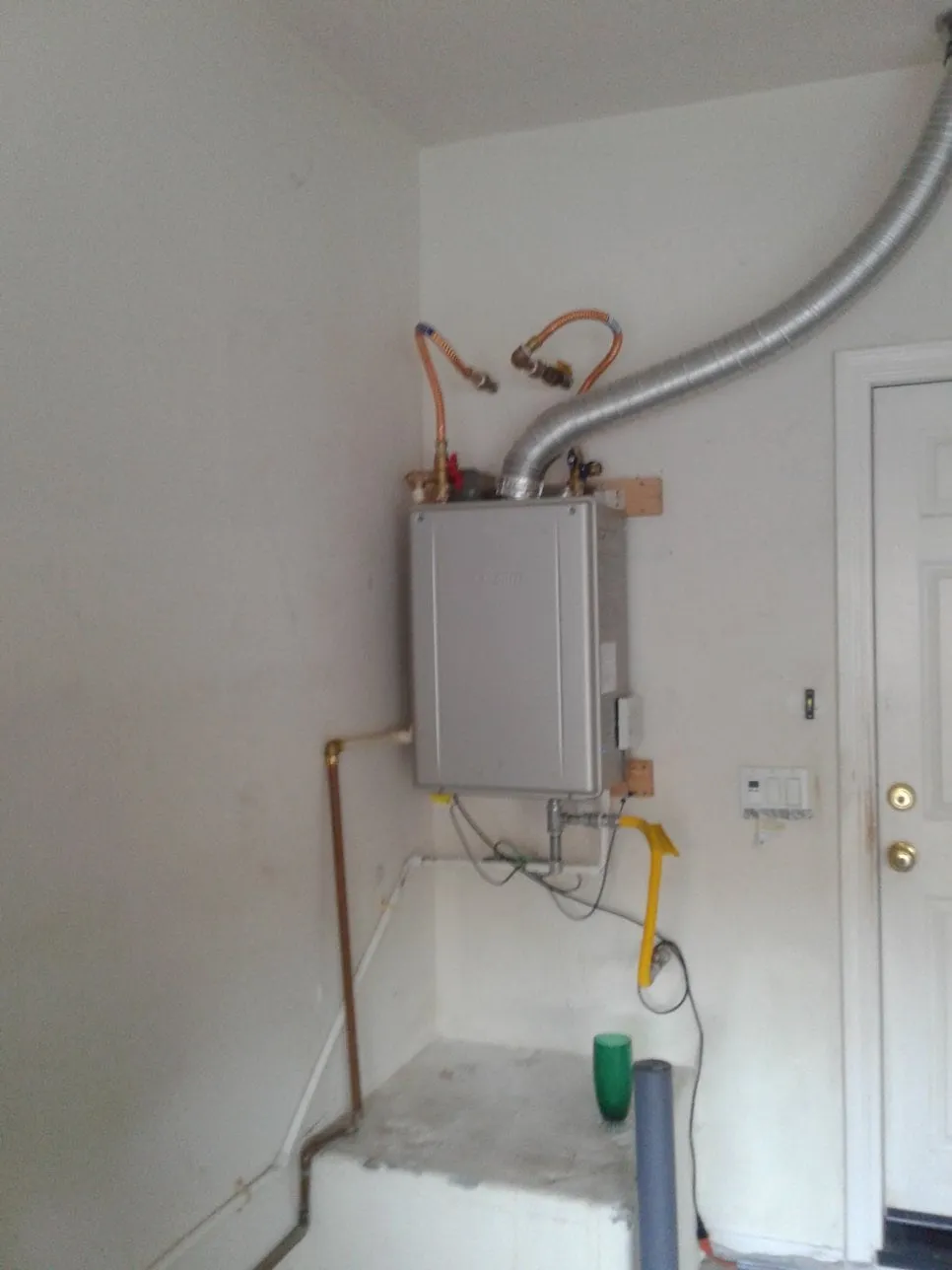
Tank and tankless, side by side
A tank water heater keeps 30 to 80 gallons hot and ready, then takes time to recover once it is used up. A tankless unit heats water as it passes through, so it never runs out, but it can only heat so many gallons a minute. Here is how the two compare in a Santa Clarita Valley home.
| Tank | Tankless | |
|---|---|---|
| What moves the price | The tank size, the fuel, and whether the existing gas line and vent can be reused | The unit’s capacity, and any gas line, venting and condensate drain work the house needs |
| SoCalGas rebate | Available for a qualifying high-efficiency tank (55 gallons or less, UEF 0.64 or better) | Available when it replaces a tank in a single-family detached home |
| Hot water | What the tank holds, then a wait while it recovers | Continuous, up to the unit’s flow rate |
| Space | A floor-standing cylinder | A wall-mounted box |
| Typical life | Depends on the model, the water and upkeep | Depends on the model and on regular descaling |
| Upkeep | Draining sediment from the tank | Descaling the heat exchanger |
| In a power outage | A standard gas tank with a pilot keeps heating | Most gas units stop, since their controls need power |
SoCalGas lists $300 to $575 for a qualifying high-efficiency tank and $80 to $1,500 when a high-efficiency tankless unit replaces a tank in a single-family detached home. The rebates run first come, first served, through December 31, 2026 or until the funds are gone. TECH Clean California’s single-family heat pump incentives were fully reserved as of November 14, 2025, and the federal energy efficiency credit covered improvements made through December 31, 2025, so neither helps with a purchase now.
What it costs to switch
Upfront cost is where a tank usually wins. A like-for-like tank swap reuses the gas line, the vent and the space. A first tankless install often needs a larger gas line, new venting through a wall or the roof, and on condensing models a drain for condensate, and each of those adds to the job.
Both need a permit. In the City of Santa Clarita the fees for a water heater changeout permit come to $102, plus the 10% record maintenance fee where it applies, from the city’s 2026 to 2027 schedule, and the city issues it as an instant permit. In the county areas of the valley the fees come to $65.82. Every new water heater in California has to be braced, anchored or strapped against earthquakes.
The price for your job is the one you agree with the shop before work starts.
Hot water supply: how many showers at once
A tank’s limit is its volume. A 50-gallon tank covers a couple of showers back to back, then needs time to recover. A tankless unit’s limit is its flow rate, measured in gallons per minute at a given rise in temperature. Two showers and a dishwasher at once can ask for more than a smaller unit can heat, and the water at the far fixture turns lukewarm.
So size matters more with tankless. The unit is sized for the most hot water your household draws at the same moment, and for how cold the incoming water is, which drops in winter.
Tankless water heaters and hard water
Santa Clarita Valley water is hard. SCV Water’s 2026 report, covering 2025, puts its groundwater at an average of 354 mg/L of hardness, about 20.7 grains per gallon, and its imported surface water at about 160 mg/L, about 9.4 grains. Calcium and magnesium are what make water hard, and as SCV Water’s report puts it, hardness can cause scaling. In a drought the valley leans more on groundwater, so the water can seem harder still.
Scale is a problem for both kinds of heater, in different ways. In a tank it settles as sediment on the bottom, where it insulates the water from the burner and shortens the tank’s life; draining the tank clears some of it. In a tankless unit it coats the narrow passages of the heat exchanger, cuts the flow and the efficiency, and eventually trips an error code. Manufacturers call for flushing the heat exchanger with a descaling solution on a schedule, and water this hard calls for doing it more often.
Automatic salt-based softeners are not allowed anywhere in the valley, so the help has to come from the options allowed for scale. Water softeners covers what each can do here.
Swapping a tank for tankless
Replacing a 50-gallon tank with a tankless unit is a common upgrade, and it is usually possible. Before the old tank comes out, check three things:
- The gas line. A tankless unit burns far more gas at full fire than a tank, so the line from the meter often has to be larger.
- The vent. Tankless units need their own vent, of the type the maker specifies; the old tank’s vent usually can’t be reused as it is.
- The condensate. Condensing models drain a little acidic water and need somewhere to send it.
If those work out, the swap is straightforward. If they don’t, a new high-efficiency tank may be the better buy, and it still qualifies for a SoCalGas rebate. Plumbing by Kirk does both: tankless water heater installation and water heater replacement.
To find out whether your house suits a tankless unit, or to have a new tank priced, call the shop.
Sources
7 cited
- SCV Water, 2026 Consumer Confidence Report (hardness; grains per gallon computed at 17.1 mg/L per grain) and drought and hard water, read October 12, 2026
- SoCalGas, rebates and incentives, read October 12, 2026
- TECH Clean California, incentives and IRS, Energy Efficient Home Improvement Credit, read October 12, 2026
- City of Santa Clarita, instant online permits and Building and Safety fee schedule 2026 to 2027, read October 12, 2026
- LA County plumbing permit fees 2026 to 2027, read October 12, 2026
- LA County Sanitation Districts, Santa Clarita Valley chloride control (the softener ban), read October 12, 2026
- California Health and Safety Code section 19211 (water heater strapping)