Tankless water heater installation
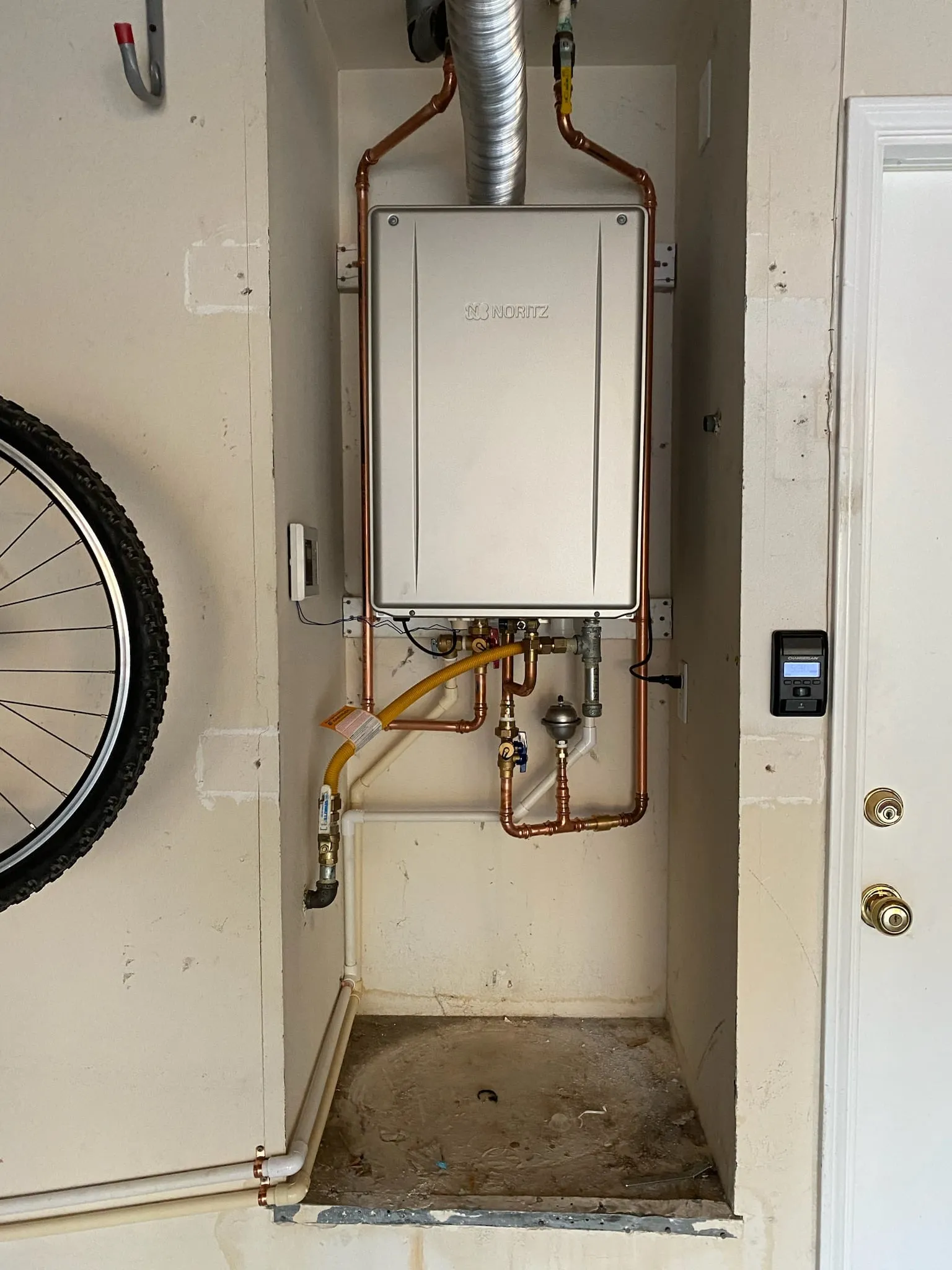
A tankless install is as much about what feeds and vents the unit as about the unit itself, and that is where one house differs from the next.
The unit hangs on a wall, inside the house or garage, or outdoors on a model built for it. Indoor units vent through a wall or the roof in the vent material the maker calls for; outdoor models vent at the unit itself. Most units need electric power for their controls and fan, which is why a gas tankless heater usually stops during a power outage. Service valves on the water lines let the unit be descaled later. Condensing models, the most efficient kind, also need a drain for their condensate.
A tankless burner heats water as it passes through, so when it fires it draws much more gas than a tank heater’s burner, and the line from the meter has to carry that on top of the stove, the dryer and anything else it feeds. If it can’t, the line has to be upsized, which adds to both the work and the price.
A tankless install needs a permit like any water heater, and water heater replacement lists the permit offices and fees by address. The SoCalGas rebate for swapping a tank for a qualifying unit is in the note under the price table.
Sizing a tankless water heater
A tank is sized by the gallons it holds; a tankless unit by the gallons a minute it can heat, and by how many degrees. Two numbers decide it: the most hot water the household draws at one moment, and how cold the water comes in, which changes with the season. The colder the incoming water, the fewer gallons a minute a unit can bring up to temperature.
That is why square footage is a poor guide. A two-bathroom house where two showers often run together needs more capacity than a larger house where they rarely do. When one unit can’t cover the busiest moment, two can be piped side by side to share it.
Tankless water heater repair
A tankless unit reports most faults as a code on its display. Note the code and the make before you call, since the same code can mean different things on different makes. The usual causes:
- Ignition and flame faults. The burner won’t light or loses its flame: a gas supply that can’t keep up, a dirty flame sensor or a failed igniter.
- Flow and overheat faults. Scale in the heat exchanger restricts the flow and traps heat. In valley water, it is the first thing to check.
- Venting and condensate faults. A blocked vent or a backed-up condensate line shuts the unit down to protect it.
- No display at all. Usually a power problem: the outlet, the breaker or a fuse inside the unit.
When a tankless unit runs cold
Not every cold shower is a failure. A tankless unit needs a minimum flow before it fires, so a fixture opened only a little may not keep it lit. Hot water that turns lukewarm when a second fixture opens usually means the unit is too small for the household’s busiest moment, or scale has cut into its capacity. Descaling fixes the scale; only a bigger unit, or a second one, fixes the size.
Tankless maintenance and descaling
In the Santa Clarita Valley, descaling is the maintenance a tankless unit can’t go without. SCV Water’s 2026 report gives the average hardness of its groundwater as 354 mg/L, and of its imported surface water as about 160, served in proportions that vary across its service area. That calcium and magnesium builds up as scale inside the heat exchanger’s narrow tubes, cutting the flow and making the burner work harder.
Tankless water heater maintenance means closing the service valves, circulating a descaling solution through the heat exchanger with a small pump, flushing it clean, and cleaning the inlet screen. The maker’s manual sets how often, and harder water argues for the shorter interval.
Treating the water before it reaches the heater helps, within the valley’s rules. Automatic salt-based water softeners are not allowed anywhere in the Santa Clarita Valley, but exchange-tank service, salt-free conditioners, reverse osmosis and carbon filters are, and the water softeners page explains which of them helps with scale. A maintenance check comes with the Family Plan, and the plan page lists the rest.
Tankless makes and models
Tankless units differ from one make to the next far more than tanks do: each has its own error codes, parts, venting rules and descaling steps. The make and model are printed on the unit’s rating label. Give them when you call, along with any code on the display.
Tankless water heaters across the valley
Water hardness isn’t the same everywhere in the valley. Around Castaic, the Hasley Canyon area is served by Los Angeles County Waterworks District 36, whose water ranged from 270 to 470 mg/L of hardness in 2025, an average of 355. SCV Water’s joint 2026 report covers both.
Kirk’s crew installs and services tankless units throughout the Santa Clarita Valley, in Valencia, Saugus, Castaic and Stevenson Ranch as well as Newhall and Canyon Country. Still choosing between a tank and tankless? The tankless vs tank guide weighs the two for hard water. To plan an install or book a repair or descaling visit, call the shop; for a repair, give the unit’s make and any code on its display.
Sources
5 cited
- SCV Water, 2026 Consumer Confidence Report (hardness for SCV Water and District 36, and why it varies), read October 12, 2026
- SCV Water, One Valley One Vision environmental report, section 3.13 (District 36 serves the Hasley Canyon area), read October 12, 2026
- SoCalGas, rebates and incentives, read October 12, 2026
- ENERGY STAR, how whole-home gas tankless water heaters work (the flow sensor, the sealed vent, and the condensate drain on condensing models), read October 12, 2026
- LA County Sanitation Districts, Santa Clarita Valley chloride control (the softener ban and the allowed options), read October 12, 2026