Clogged drains
Clogs usually build slowly. Kitchen lines collect grease and food scraps, bathroom lines collect hair and soap, and toilet lines stop on too much paper or things that should never be flushed, wipes included. A clogged drain usually warns you first: water that drains slower every week, a gurgle after the sink empties, or a smell that comes back.
Where the clog sits decides the fix. One slow fixture means the blockage is in that fixture’s own line, and a cable from the sink, tub or trap usually clears it. Several fixtures slow at once, or water rising in the tub when the toilet flushes, means the main line, the pipe every drain in the house empties into. That one is cleared from outside, at the clean-out.
If you are not sure which you have, run water in one fixture at a time and watch the lowest drains in the house, usually a tub or shower. Water coming up there while another fixture runs points to the main line.
Rooter service, drain cable or hydro jetting
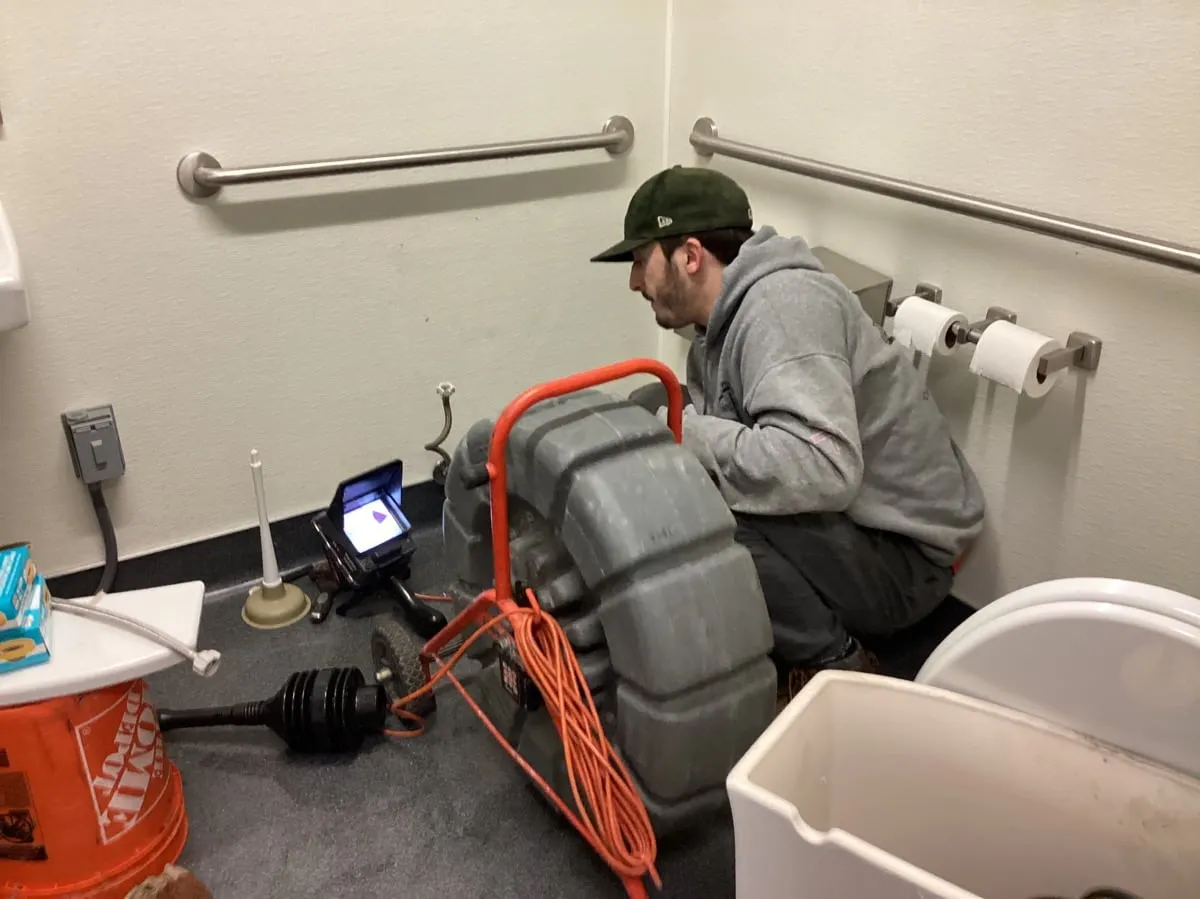
A drain cable, the machine people still call a rooter, spins a cutting head through the pipe and breaks the clog apart. It is usually the right tool for a single-fixture clog and for a main line that has stopped for the first time. It opens a path through the blockage, but it can leave grease and scale stuck to the pipe wall.
Hydro jetting sends water at high pressure through a hose with a nozzle that scours the pipe wall as it moves, clearing grease, scale and roots instead of punching a hole through them. The right tool depends on the line: a cable for an ordinary clog, jetting when grease, scale or roots line the pipe or the same drain keeps stopping. The guide to hydro jetting vs snaking explains the difference in more detail, including when jetting is the wrong choice for an old pipe.
When the main line is the problem
The signs of a main line stoppage are usually the same: several drains slow at once, toilets bubble when another fixture drains, and sewage shows up at the lowest drain in the house. Stop running water until the line is open, since everything you run has to leave through it. When sewage is already coming up inside, the emergency plumbing page has the first steps.
The line is cleared from the main line clean-out, a capped pipe usually near the foundation or in the yard. When a main line stops more than once, a camera inspection shows why: roots coming in at the joints, a sag that holds water, or a cracked pipe. Those are repairs rather than cleanings, and sewer line repair covers them.
Age is part of the picture in this valley. In the City of Santa Clarita, 30.7% of homes were built in 1979 or earlier, by the Census Bureau’s 2020 to 2024 estimates, and the city’s own sewer mains are predominantly vitrified clay, about half of them laid between 1960 and 1979. The city’s sewer plan expects cracks, joint separation and root intrusion to develop as those lines age.
Drain cleaning in Valencia and across the valley
Plumbing by Kirk’s shop is in Valencia, and the crew clears drains across the Santa Clarita Valley: drain cleaning in Valencia, Newhall, Saugus and Castaic, plus Canyon Country and Stevenson Ranch.
A clog inside your property is yours to clear. Sewage coming out of a manhole or into the street is the public sewer: in the City of Santa Clarita, LA County’s Sewer Maintenance Division looks after the city’s sewers and takes overflow calls at (800) 675-4357. Wastewater from across the valley ends up at the Valencia and Saugus water reclamation plants.
Keeping drains clear between visits
Clogs usually start with what goes down the drain. A few habits keep lines open longer:
- Scrape grease and food into the trash, not the sink, even with a garbage disposal.
- Put strainers in tub and shower drains to catch hair.
- Flush only toilet paper.
- Clear leaves and silt from yard drains before the rains, and make sure water leaving the yard reaches the street.
- If a drain is slowing down, have it cleared before it stops.
Homes on the Family Plan get a maintenance check and a stoppage clearing included, a good time to look at a drain that has been slowing down.
When a drain has stopped, call the shop.
Sources
4 cited
- US Census Bureau, American Community Survey 2020 to 2024, table B25034 (homes by year built, City of Santa Clarita), read October 12, 2026
- City of Santa Clarita, Sewer System Management Plan 2025 (sewer mains), read October 12, 2026
- City of Santa Clarita, sanitation (who maintains the city’s sewers), read October 12, 2026
- LA County Sanitation Districts, Santa Clarita Valley chloride control (where valley wastewater goes), read October 12, 2026