Toilet repair
Toilet repair usually starts with one of a few signs. A toilet that keeps running, or refills on its own every so often, usually has a worn flapper or a fill valve that sticks open inside the tank; the EPA’s WaterSense program says a worn flapper can make a toilet flush on its own or leak thousands of gallons a year without a sound. To check, put a few drops of food coloring in the tank and leave it 10 minutes without flushing: color in the bowl means the tank is leaking into it.
Water on the floor around the base can come from the seal between the toilet and the drain, and replacing that seal means lifting the toilet. The plumbing code calls for a toilet to be bolted firmly to the floor and the drain, so one that rocks needs resetting. And one that clogs over and over may have something caught in its trap, or a partial blockage further down the line, which is a job for drain cleaning.
SCV Water’s free Water Efficiency Kit for its customers includes a replacement toilet flapper and leak detector dye tablets. The agency lists no rebate for a new toilet.
Faucets
A dripping faucet is usually a worn part rather than a failed faucet. The EPA’s WaterSense program names old and worn washers and gaskets as a frequent cause of faucet leaks, and on a cartridge faucet a drip from the spout usually means a new cartridge. In water as hard as the valley’s, mineral deposits also build up in the aerator, the small screen at the end of the spout, so weak flow from one faucet is worth checking there first.
Under the sink, the shutoff valves and the supply lines to the faucet wear out too, and a shutoff that won’t close can’t stop the water when something above it leaks.
Garbage disposal repair and installation
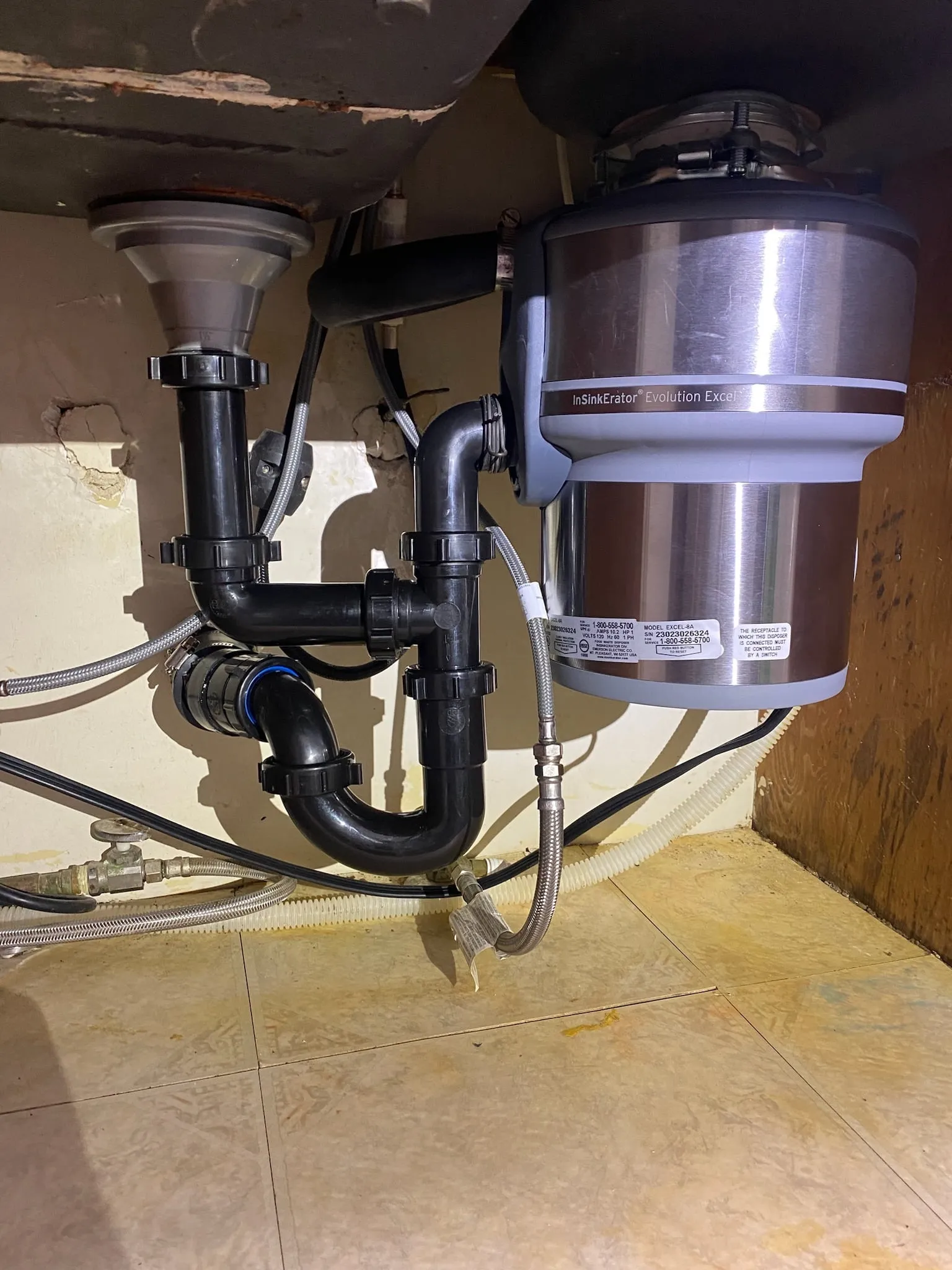
A disposal that hums but won’t turn is usually jammed. Many units have a socket in the center of the bottom for a hex key that frees the grinding plate, and a red reset button on the bottom as well. Switch off the power to the unit before you reach anywhere near it, and never put a hand inside.
A leak can come from the sink flange, the drain or dishwasher connection, or the unit itself, and where it comes from decides whether the disposal is resealed or replaced. Garbage disposal installation means mounting the new unit to the sink, connecting it to the drain and to the dishwasher line if there is one, and running water through it to check for leaks.
Pressure regulators
The plumbing code draws the line at 80 psi: where the static pressure in a house’s water supply is higher, a pressure regulator has to bring it down to 80 or less. How high it runs depends on where the home sits. SCV Water’s customer service policy says the agency attempts to operate its system between 40 and 150 pounds per square inch, that there are times and areas outside that range, and that because of topography, among other causes, pressure is not uniform across its service area. Over 80 psi, the same policy points to the Uniform Plumbing Code: the house needs its own pressure regulating valve on the customer’s line, and once one is in, the owner looks after it.
A pressure gauge threaded onto an outside hose bib, with the tap fully open, reads the pressure. Signs of a regulator that has failed and let the pressure climb include pipes that bang or whistle when the water is shut off, more flow than expected at the fixtures, and toilets and faucets that keep leaking. When a regulator goes in under a permit, the City of Santa Clarita’s 2026 to 2027 fee schedule lists $18 for it plus the $38 permit issuance and $22 inspection fees and a 10% record maintenance fee, and LA County’s schedule for its unincorporated areas lists $24.47 for each water pressure regulator plus $41.35 to issue the permit.
Shower valves
A shower that keeps dripping after it is turned off usually needs a new cartridge in the valve. The plumbing code requires a shower valve of the pressure-balancing or thermostatic type, which guards against scalding and sudden swings in temperature, so one that runs hot and cold when a toilet flushes may have a worn pressure-balancing part, or be an older valve without one.
The valve sits behind the wall, so the job is simpler where the house has an access panel behind the shower. Without one, the valve is reached through the tile or the wall on the other side. In the City of Santa Clarita, replacing a valve concealed in the wall counts as new work that needs a permit.
Hose bibs
An outside faucet that drips or won’t shut off usually needs a new washer or stem, or a new hose bib. The plumbing code requires an outdoor hose connection to be protected by a vacuum breaker or another backflow preventer, which keeps water in a hose from being drawn back into the house’s pipes.
Water lines
The water line from the meter to the house is the owner’s: SCV Water owns and maintains everything up to the meter and the meter itself, and the line after it is the property owner’s to look after. A meter that moves while nothing in the house is running points to a leak somewhere past it; SCV Water’s two-hour meter test, set out on the leak detection page, confirms it, and the same page covers finding the leaks you can’t see.
SCV Water’s service line inventory lets you look up whether the line at your property is listed as non-lead, lead or galvanized, and in 2024 the agency told state and federal regulators that its own system is free of lead pipelines. In the City of Santa Clarita, a residential water service permit is one of the permits that can be pulled online. When the pipes inside the house keep failing one after another, repiping can be the better fix, and the guide to repair or repipe weighs the two.
Older valley homes and the 1994 fixture rule
Much of the valley’s housing predates 1994. Census Bureau figures for 2020 to 2024 put the median home in ZIP 91321, Newhall, at 1978; in 91351, Canyon Country, at 1982; and in 91355, Valencia, at 1984.
That date matters because of California’s SB 407, which covers homes built on or before January 1, 1994. The City of Santa Clarita’s handout explains it this way: when a room is altered or improved under a permit, its non-compliant fixtures are replaced with water-conserving ones, and from January 1, 2017 the law has required owners of single-family homes that age to replace all non-compliant fixtures. Non-compliant means a toilet made to use more than 1.6 gallons per flush, a showerhead that flows more than 2.5 gallons a minute, or an indoor faucet over 2.2 gallons a minute. Repairs and maintenance don’t count as alterations.
Fixture swaps and permits
In the City of Santa Clarita, replacing a faucet, sink, toilet, shower head or similar fixture with one of the same type is on the building code’s list of work exempt from a permit, though the new fixture still has to meet the state’s water-conserving standards. The code’s ordinary repairs don’t include adding, changing, replacing or moving water supply, drain or vent piping, and replacing a concealed pipe or valve counts as new work, so moving a fixture or redoing the pipes behind it goes through a permit. County addresses go to the county’s office on Valencia Boulevard. Plumbing By Kirk, Inc. pulls the permit when the city or county requires one.
The maintenance check that comes with the Family Plan is a chance to catch a running toilet or a weeping supply line before it turns into a bigger repair. For a repair now, call the shop and say what is leaking, running or stuck.
Sources
8 cited
- City of Santa Clarita, 2025 building code amendments (fixtures exempt from a permit, ordinary repairs, concealed pipes and valves as new work) and instant online permits, read October 12, 2026
- City of Santa Clarita, SB 407 handout (water-conserving fixtures), read October 12, 2026
- City of Santa Clarita, Building and Safety fee schedule 2026 to 2027 and LA County plumbing permit fees 2026 to 2027 (pressure regulators), read October 12, 2026
- 2025 California Plumbing Code, IAPMO read-only edition (sections 402.3 and 402.6 on setting toilets, 408.4 on shower valves, 603.5.7 on hose connections, 608.2 on water pressure), read October 12, 2026
- SCV Water, Customer Service Policy, August 2026 (pressure, regulators on the customer’s line, the meter and the customer’s line), read October 12, 2026
- US EPA WaterSense, Fix a Leak Week (flappers, faucet washers, the dye test) and SCV Water, Fix a Leak (the meter test), read October 12, 2026
- SCV Water, residential rebates (the Water Efficiency Kit), Lead and Copper Rule page (the service line lookup) and service line inventory release, October 7, 2024, read October 12, 2026
- US Census Bureau, American Community Survey 2020 to 2024, table B25035 (median year built, ZIPs 91321, 91351 and 91355), read October 12, 2026