Repair or repipe?
A leak repair fixes one spot: a fitting, a valve, a supply line or a short section of pipe. A repipe replaces the hot and cold supply lines that carry water through the house. Neither one is better in general; the question is which one fits your pipes, and what you are seeing usually says.
| What you’re seeing | What it usually points to | Usually the fix |
|---|---|---|
| One leak at a fitting, valve or supply line, on pipe that is otherwise sound | A worn part | A repair |
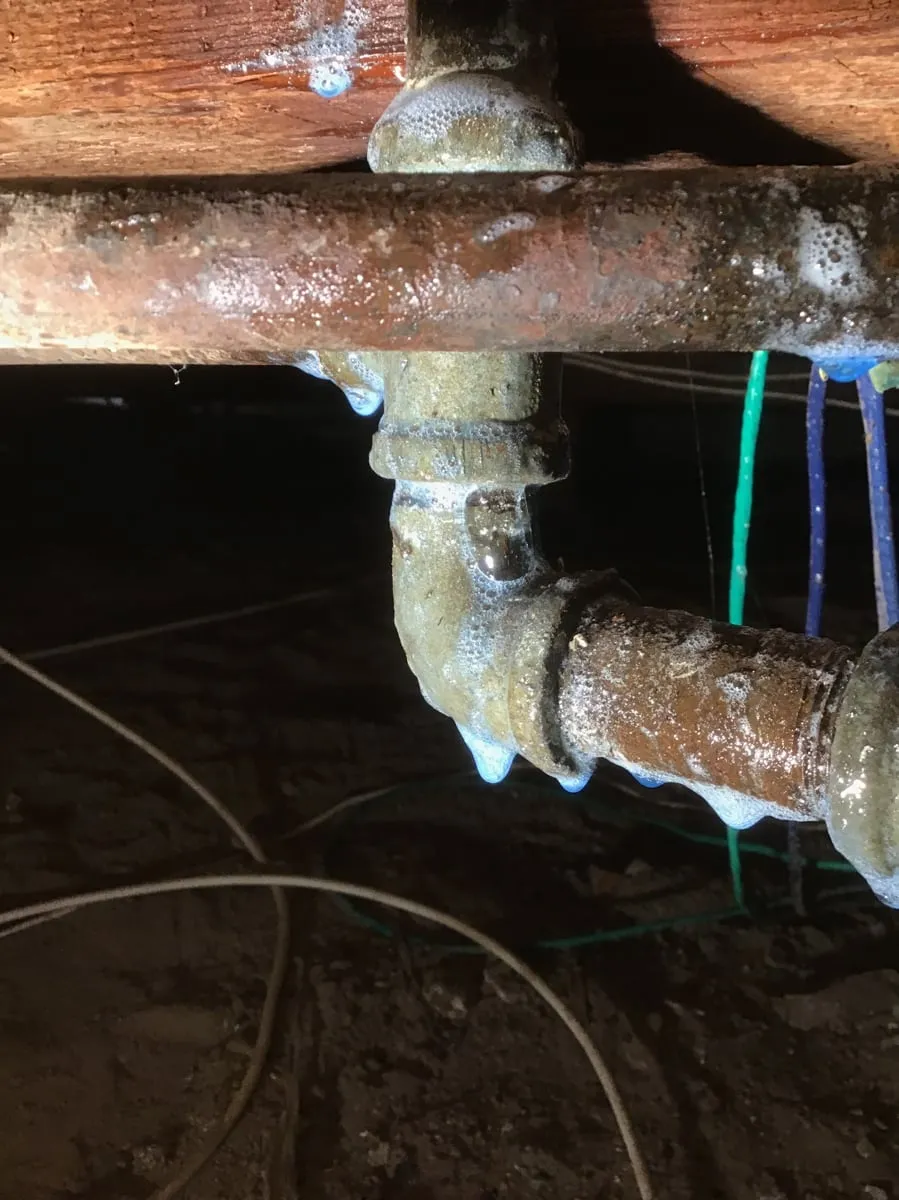
| Leaks that keep turning up in new places on the same lines | Pipe wearing out along its length | A repipe, whole house or partial |
| Rusty water from cold taps as well as hot | Galvanized steel somewhere in the lines | Replacing the galvanized pipe |
| Rusty water from the hot taps only | Rust in the water heater | The water heater, not the pipes |
| Low flow at one fixture or one bathroom | The fixture (a clogged aerator, a flow restrictor, a faulty faucet) or the pipe that feeds it | A fixture repair, or that run of pipe |
| Low flow through the whole house, with every valve fully open | Supply pipe clogged with rust and mineral deposits, if the supply pressure checks out | A repipe |
| Galvanized pipe joined to copper or brass | A risk of corrosion where the two metals meet | A close look, then a repair or a repipe |
| A second slab leak | Other lines under the floor, usually as old as the one that failed | A reroute or a repipe |
The rows on rust, flow and mixed metals follow the Residential Rehabilitation Inspection Guide from the US Department of Housing and Urban Development (HUD), written for judging how much of an older home’s systems can be kept.
Between a single repair and a whole house repipe sits pipe replacement on part of the system, such as the lines to one bathroom or a stretch with a history of leaks. That is a partial repipe, worth pricing when only part of the system is failing.
When to repipe
Age alone doesn’t decide it, and neither does one leak. HUD’s guide names a pipe’s material and its age as the two most important factors, and it calls for checking every pipe, whatever it is made of, for wet spots, discoloration, pitting, mineral deposits and leaking or worn fittings. What those signs mean depends on the pipe:
- Galvanized steel rusts and collects more mineral deposits than most piping. HUD’s guide puts its service life at anywhere from 20 to 50 years, depending on the quality of the pipe and its joints and on the mineral content of the water it carries. Rusted fittings and rust-colored water, especially from hot lines, are signs of advanced wear, and low flow and low pressure are likely to mean the pipe is clogged with rust and minerals.
- Copper, by HUD’s guide, has a normal service life of 50 years or more and usually doesn’t clog with mineral deposits. Its advice is to leave copper in place unless it shows obvious deterioration, leaks or restricted flow. When copper does leak, it is usually near joints and at supports.
- Mixed metals. Galvanized pipe joined to copper or brass is a warning sign of its own. HUD’s guide calls for a close look for corrosion where the metals meet, and for a dielectric coupling between dissimilar metals.
The water matters too. SCV Water’s 2026 Consumer Confidence Report lists groundwater hardness from 220 to 480 mg/L and imported surface water from 150 to 170, and says hardness can cause scaling. Hardness is part of the mineral content HUD’s guide ties to the life of galvanized pipe.
Two checks from HUD’s guide help separate a pipe problem from something smaller:
- Rusty water. If it comes from the hot taps only, the rust is more likely in the water heater than in the pipes.
- Low flow. Low flow at one fixture points to that fixture or the pipe feeding it. Low flow everywhere is either the supply pressure or something between where the water enters the house and the first fixture; with the valves fully open and nothing pinching the line, the pipe is probably clogged. Flow that is weaker from hot taps than from cold points to the water heater or, more likely, to buildup in the hot lines, which forms faster in hot water.
A repipe replaces only the supply lines. The drains are a separate system, and a drain that keeps clogging is a cleaning question, covered in hydro jetting vs snaking.
What moves the repipe cost
A repipe is priced house by house, because no two houses have the same plumbing. These are the things that move the price:
- Fixtures and bathrooms. Every sink, toilet, tub and shower, the water heater, the washer and each hose bib gets its own connection on the new lines.
- One story or two. A second floor means lines run up through the walls and a longer route.
- PEX or copper. PEX bends around obstructions, so it needs fewer fittings, and its installed cost usually runs lower than rigid metal pipe’s; rigid copper needs a fitting where it changes direction. The repiping page compares PEX and copper in more detail.
- The route. An open attic is quicker to work through than finished ceilings and walls with no access.
- Openings and patching. The new lines go in through openings in the drywall, and patching, texture and paint may or may not be in the price.
- The permit. A flat fee per home in the City of Santa Clarita, a per-fixture fee in the county areas.
| Job | What moves the price |
|---|---|
| Leak repair | What failed (a fitting, a valve or a section of pipe) and how hard it is to reach |
| Partial repipe | How much of the system is replaced, and how easy the old and new lines are to reach |
| Whole house repipe | The number of bathrooms and fixtures, one story or two, and PEX or copper |
| Openings and patching | How many openings the route needs, and whether patching them is part of the job |
The price for your job is the one you agree with the shop before work starts.
The permit is the one piece with a published price. Repipe is one of the City of Santa Clarita’s instant permits for homes, and the city’s 2026 to 2027 fee schedule lists a single-family repipe at $129 per unit, with the $38 permit issuance and $22 residential inspection fees on top: $189, plus the 10% record maintenance fee where it applies. The schedule prints no total; the $189 adds up those three lines. In the county’s unincorporated parts of the valley, Stevenson Ranch and Castaic among them, LA County Public Works’ plumbing fee schedule, in effect since July 1, 2026, prices replacing water piping at $10.11 for each fixture, water treatment device or water-using appliance on the replaced piping, plus $41.35 to issue the permit.
Plumbing by Kirk does both kinds of job, the leak repairs and the repipes: the page on repiping in Santa Clarita covers the job.
The cost of one more repair
For one leak on sound pipe, a repair is the smaller bill and the right call. When the leaks keep coming, each one costs more than the repair itself:
- The water. SCV Water charges for all the water that passes through the meter, and a leak in the customer’s own plumbing is the customer’s responsibility. The agency may adjust a high bill after a leak, but it makes no more than one such adjustment in a rolling 60-month period, and its policy describes the adjustment as relief for the rare leak that is uncommon or catastrophic and beyond the customer’s control. How to ask for one is under high water bill on the leak detection page.
- The permit. In the City of Santa Clarita, repairing a leak is exempt from a permit, but if a concealed water pipe or valve has to be removed and replaced with new material, the building code treats that as new work, with a permit and an inspection.
- The openings. A leak inside a wall or under a floor has to be reached, and every opening has to be patched afterwards.
- The damage. Water that ran before the leak was found can spoil drywall, flooring and cabinets, and that repair is separate from the plumbing.
So before pricing the next repair, count the last few. Lines that went in together tend to age together, so several leaks on the same lines are often a sign of more to come. Leak detection finds a leak you can’t see, and plumbing repair covers the fittings, valves and supply lines that fail on their own.
Slab leaks: repair, reroute or repipe
A slab leak is water escaping from a supply line buried in or under the concrete floor. There are three ways to deal with one, and the house matters as much as the leak:
- A spot repair opens the floor and the slab at the leak and replaces the damaged section. It fits a single leak on pipe that is otherwise in good shape.
- A reroute runs a new line around the problem, overhead or inside the walls, and caps the old one where it is. It fits when the line has failed before, or when the floor over the leak is tile, hardwood or cabinetry that would be costly to take up.
- A repipe replaces the supply lines through the house, usually overhead, and leaves the old lines under the slab out of service.
One slab leak is usually a repair or a reroute. A second slab leak, leaks on more than one line, or the other signs above are when a repipe belongs in the comparison, because the lines under the floor are usually as old as the one that failed. Slab leak repair explains the first two options. Either repair starts with finding the leak, and a spot repair needs its exact spot, so that no more of the floor is opened than the repair needs.
Questions to ask before you decide
Whoever prices the job, these questions make two quotes comparable:
- What failed, and is it the pipe or one part?
- Is the price for PEX or copper, and why that one for this house?
- Does it include the permit, the openings and the patching, and who does the texture and paint?
- Are new shutoff valves at the fixtures part of the job?
- What happens to the old lines: removed, or capped and left in place?
- How long will the water be off, and on which days?
- For a partial repipe: which lines stay, and how old are they?
To have your pipes looked at and priced, call the shop and say how many leaks the house has had so far.
Sources
7 cited
- US Department of Housing and Urban Development, Residential Rehabilitation Inspection Guide, February 2000, prepared by the National Institute of Building Sciences (chapter 6: water supply pipe by material, rusty water, low flow, mixed metals), read October 13, 2026
- NAHB Research Center, Design Guide: Residential PEX Water Supply Plumbing Systems, November 2006, prepared for the Plastics Pipe Institute, the Plastic Pipe and Fittings Association and HUD’s Partnership for Advancing Technology in Housing (fittings and installation cost), read October 13, 2026
- SCV Water, 2026 Consumer Confidence Report (hardness), read October 13, 2026
- SCV Water, Customer Service Policy, August 2026 (sections 8.14 and 12.10: leaks on the customer’s side of the meter and bill adjustments), read October 13, 2026
- City of Santa Clarita, Instant Online Permits and Building and Safety fee schedule 2026 to 2027 (the repipe permit and its fees, effective August 24, 2026; the $189 adds three lines, since the schedule prints no total), read October 13, 2026
- City of Santa Clarita, 2025 building code amendments (SCMC 18.02.040: leak repairs and replaced concealed pipe), read October 13, 2026
- LA County Public Works, plumbing permit fees effective July 1, 2026 (permit issuance and replacing water piping), read October 13, 2026