
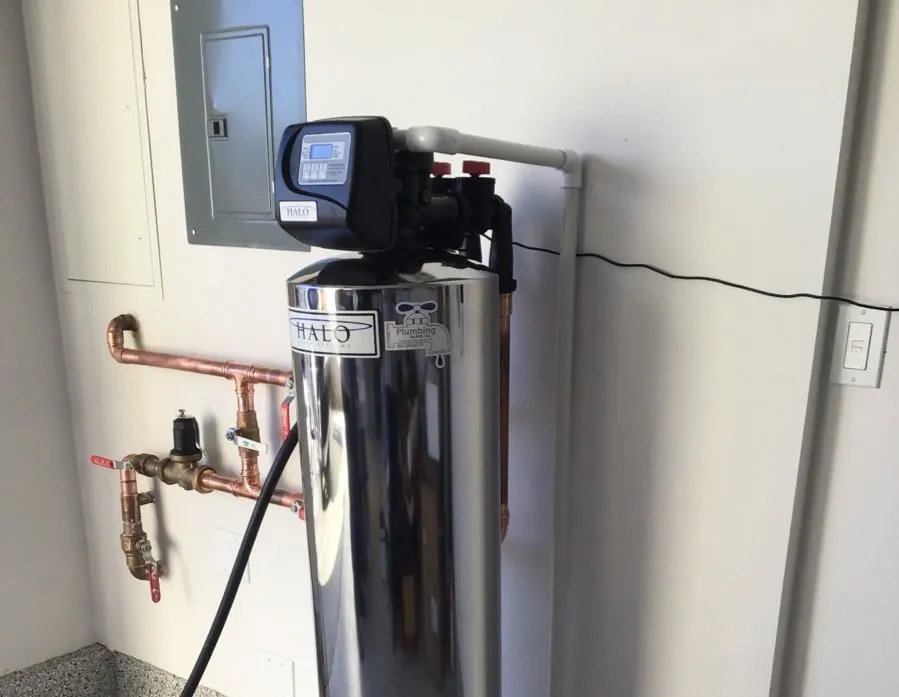
Why salt-based softeners are banned here
Automatic salt-based water softeners are prohibited throughout the Santa Clarita Valley, inside the City of Santa Clarita and out in the county communities around it, such as Stevenson Ranch, Castaic and Valencia by FivePoint. The ban comes from the Los Angeles County Sanitation Districts’ ordinances, and the city writes its own version into its plumbing code.
The reason is chloride. A softener that regenerates with salt flushes salty brine down the drain, and the valley’s wastewater goes to the Valencia and Saugus water reclamation plants. That chloride has to be taken out before the water is released into the Santa Clara River. Potassium chloride instead of salt doesn’t change anything: the ban covers softeners that use rock salt, sodium chloride or potassium chloride.
The full rules, from the 2003 ban and Measure S to brine sent onto the yard or into a dry well, are under the valley’s softener ban, with the city’s own code and the Sanitation Districts’ help line.
How hard Santa Clarita water is
SCV Water’s 2026 water quality report puts the 2025 hardness of its groundwater at 354 mg/L on average, or about 20.7 grains per gallon, and of the imported state water at about 160 mg/L, or roughly 9.4 grains. On the US Geological Survey’s scale, anything over 180 mg/L counts as very hard. That hardness is calcium and magnesium, and it is what forms scale in water heaters and pipes when the water is heated, and spots on glass and fixtures where the water dries.
How hard the water at your tap is depends on how much groundwater is in the mix, which varies across SCV Water’s area and rises in a drought; the valley page has the supply figures. So a house in one part of the valley can see harder water than a house in another, and the same house can see harder water in a dry year.
Water softener options in Santa Clarita
The Sanitation Districts accept any household water treatment system that doesn’t need salt added, and they list the common ones: portable exchange tank softeners, salt-free water conditioning systems, and other treatment such as reverse osmosis and carbon filtration. They don’t endorse any particular product or system.
| Option | What it does | Where it goes | Upkeep |
|---|---|---|---|
| Salt-free conditioner | Meant to cut scale; leaves the minerals in the water | On the main line, for the whole house | Media replaced on the maker’s schedule |
| Portable exchange tanks | Softens the water; the tanks are regenerated off site | On the main line, for the whole house | A technician swaps the tanks every 2 to 4 weeks |
| Whole-house carbon filter | Works on taste and smell; doesn’t soften | On the main line, for the whole house | Filter media replaced every 2 to 3 years |
| Reverse osmosis | Filtered water for drinking and cooking | Under the kitchen sink, with its own faucet | Sediment filters about every 6 months, the membrane every 3 to 5 years |
The upkeep figures are the Sanitation Districts’ general ones; each maker sets its own schedule.
The right fit depends on what you want to fix. Scale in the water heater and on the fixtures points to a conditioner or exchange tanks. The taste of the tap water points to a carbon filter or reverse osmosis. Some homes pair two, such as a conditioner on the main line and reverse osmosis at the kitchen sink, and some systems combine several technologies in one.
Salt-free water conditioning
A salt-free conditioner sits on the main line where it enters the house and treats all the water that comes in. It doesn’t take the calcium and magnesium out of the water. It is meant to change how those minerals behave, so less of them settles as scale in pipes, water heaters and fixtures. The Water Quality Association, the water treatment industry’s trade group, notes that these devices don’t reduce the total calcium or magnesium in the water and aren’t proven to produce soft water, so the aim is less scale rather than softer water.
Because it uses no salt and sends no brine to the sewer, salt-free water conditioning is one of the Sanitation Districts’ acceptable alternatives, and the City of Santa Clarita’s plumbing code says salt-free conditioning systems are permitted when the Sanitation Districts approve them.
The unit has to be sized for the flow your home draws at once, which depends most on the number of bathrooms and the size of the main line. Scale also builds up in the heat exchanger of a tankless water heater, where it cuts flow and efficiency; makers call for descaling it on a schedule, and more often where the water is harder.
Exchange tanks
If you want softened water for the whole house, the Sanitation Districts point to portable exchange tanks. They soften the water by ion exchange, as the banned units do, but a technician swaps the spent resin tank for a freshly regenerated one, every 2 to 4 weeks by the Sanitation Districts’ guide. The regenerating happens away from your home, so no brine goes into the sewer from your house, and the tanks are rented from the service company rather than bought.
The city’s plumbing code makes an exception to its ban for exactly this setup: portable exchange-tank systems installed and maintained by a company, with no brine discharged into the public sewer. The tanks need space near the main line and access for the swaps.
Whole-house water filters
A whole-house carbon filter sits on the main line and works on the taste and smell of all the water in the house; the Sanitation Districts describe carbon filtration as improving taste and odor. Carbon doesn’t soften the water or stop scale, so a home that wants both pairs it with a conditioner, sometimes in a single system.
If a seller says a filter reduces a particular health-related contaminant, California requires that model to be on the State Water Board’s list of water treatment devices for that claim. Ask to see the listing before you buy on the strength of it.
Reverse osmosis
Reverse osmosis installation here means an under-sink system for drinking and cooking water. Pressure pushes the water through a semi-permeable membrane, and the treated water is usually held in a small storage tank and comes out of its own faucet at the sink. It treats one tap rather than the house, and it sends part of the water it takes in down the drain as it works: the EPA’s WaterSense program puts a typical under-sink unit at five gallons or more down the drain for every gallon it treats, and labeled models at 2.3 gallons or less.
SCV Water’s 2026 report put total dissolved solids at an average of 645 mg/L in its groundwater and 310 mg/L in its surface water. Reverse osmosis takes dissolved minerals, hardness included, out of the water at that one tap, and it is one of the Sanitation Districts’ acceptable alternatives.
Removing an old softener
Some homes still have a salt-based unit from before the ban. Taking one out is a plumbing job: the unit comes off the line, the line is reconnected, and its drain connection is capped. Two Sanitation Districts programs can cover the cost, and in both the work is done by a plumber the Sanitation Districts authorize:
- City of Santa Clarita residents may be eligible for the free removal program. The softener has to be owned by the applicant, so rented units don’t qualify, and the home has to be on the Santa Clarita Valley Sanitation District’s sewer. Once an application is approved, the Sanitation Districts send a list of the plumbers authorized to remove it at no cost.
- In Valencia by FivePoint, a softener installed before October 1, 2026 can be sold back for up to 100% of its purchase price and removed at no charge by a plumber the Sanitation Districts authorize. The buy-back ends on September 30, 2027.
Water treatment across the valley
The rules and the water shift a little from town to town:
- Valencia: Valencia by FivePoint came under the Newhall Ranch Sanitation District’s own softener ordinance on October 1, 2026, and the CC&Rs for FivePoint’s Valencia community already prohibit installing them.
- Stevenson Ranch and Castaic: both are named in the Sanitation Districts’ description of the ban. Homes in the Hasley Canyon area of Castaic get their water from LA County Waterworks District 36, whose hardness averaged 355 mg/L in the same 2026 report. In these county areas, the county’s permit fee for water-treating equipment is $24.47 a piece, plus $41.35 to issue the permit, under its 2026 to 2027 plumbing fees.
- Saugus: residents of unincorporated LA County can take softener salt to the Saugus Water Reclamation Plant at 26200 Springbrook Avenue at no charge, Monday to Saturday from 7:00 a.m. to 3:30 p.m. The Sanitation Districts say salt and potassium chloride go out as household hazardous waste, and any resident can bring salt to the Santa Clarita household hazardous waste collection events.
To talk through the water in your own home, call the shop.
Sources
11 cited
- LA County Sanitation Districts, Santa Clarita Valley chloride control (the ban, Measure S, the allowed options, Valencia by FivePoint, the Valencia plant), read October 12, 2026
- LA County Sanitation Districts, acceptable alternatives and vendors (what each allowed option does, upkeep intervals), read October 12, 2026
- LA County Sanitation Districts, FAQs for residents (exchange tanks for soft water), read October 12, 2026
- LA County Sanitation Districts, Free Removal and Buy-Back Program (removal, buy-back, salt disposal, exchange tanks as rentals), read October 12, 2026
- City of Santa Clarita, 2025 building code amendments (California Plumbing Code 714.7 as amended), read October 12, 2026
- SCV Water, 2026 Consumer Confidence Report (hardness, total dissolved solids, District 36; some surface water data is from 2024; grains per gallon computed at 17.1 mg/L per grain) and drought and hard water, read October 12, 2026
- US Geological Survey, Water-Resources Investigations Report 02-4045, table 3 (hardness classes, scale in water heaters and pipes), read October 12, 2026
- Water Quality Association, scale deposits and residential water treatment design (salt-free devices, sizing for flow and daily use), read October 12, 2026
- US EPA WaterSense, point-of-use reverse osmosis systems (how reverse osmosis works, reject water), read October 12, 2026
- LA County plumbing permit fees 2026 to 2027, read October 12, 2026
- California Health and Safety Code sections 116825 to 116855 (claims for water treatment devices), read October 12, 2026