
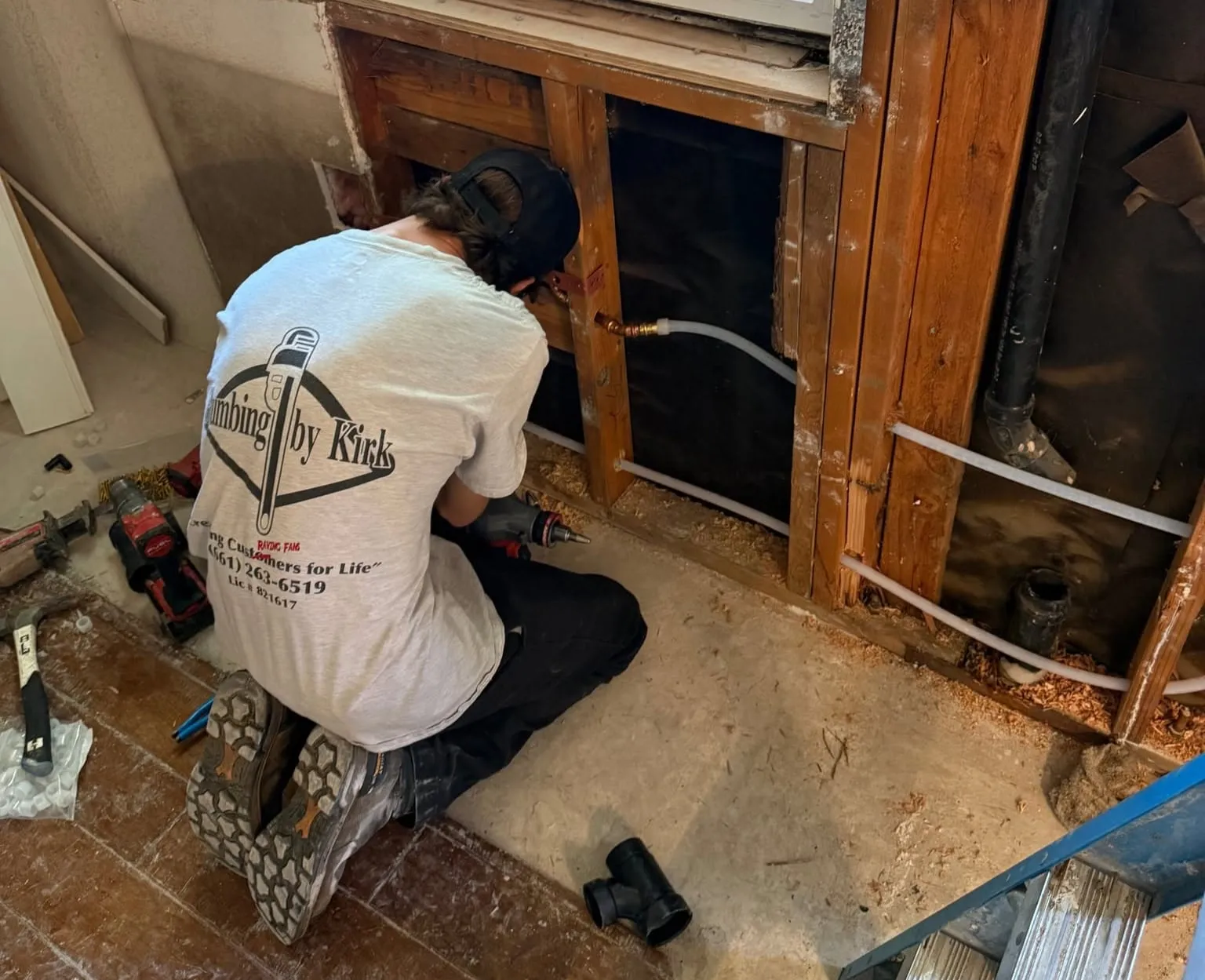
Signs of a hidden water leak
A hidden leak usually leaves clues before any water shows. The meter keeps moving when nothing in the house is running. The bill climbs although nothing about how you use water has changed. You hear water running in a wall or under the floor with every tap closed, or the water heater fires when nobody has used hot water. A patch of floor feels warm underfoot, a ceiling stain spreads, paint bubbles, or a closet starts to smell musty.
Water follows pipes, framing and the top of the slab before it surfaces, so a stain often appears some distance from the leak itself. That is why the search starts at the meter rather than at the wet spot. If water is running where you can see it, don’t wait for a search: close the main shutoff valve and see what to do in a plumbing emergency.
High water bill
SCV Water bills for every gallon that passes through your meter, leaks included, so a leak on your side of the meter usually shows up on the bill before it shows up anywhere else. SCV Water suggests two checks you can run yourself:
- The meter test. Read the meter, use no water for two hours, then read it again. If the reading has changed at all, you probably have a leak.
- The toilet test. Put a drop of food coloring in the toilet tank. If any color shows up in the bowl after 10 minutes, the toilet is leaking, and a worn flapper is often the cause. Flush right afterwards so the tank doesn’t stain. SCV Water hands out free leak-detection tablets for this test at its Customer Care office, 24631 Avenue Rockefeller in Valencia.
For the bill itself, SCV Water’s yardstick is a colder month such as January or February: if a family of four used more than 12,000 gallons, there are serious leaks.
SCV Water’s newer meters make a leak easier to catch. In July 2022 it started swapping manual meters for advanced meters it reads remotely, and the upgrades have reached Valencia, Tesoro, Castaic, Stevenson Ranch, Newhall and Canyon Country, with the remaining areas estimated for January 2027. With one of these meters you can see your hourly use in SCV Water’s customer portal and get alerts about continuous use, which may mean a leak.
If a leak has already run up a bill, SCV Water may adjust it once the leak is fixed. Its Customer Service Policy (August 2026) asks you to request a billing review within 60 days of the first high bill, to find and repair the leak within 30 days of being notified, and to send proof of the repair, such as repair bills or photographs. The meter is re-read and may be tested, your use has to be back to normal, and the policy allows one adjustment of this kind in a rolling 60-month period.
If you suspect the meter itself, SCV Water tests it on written request, with a $246 deposit. If the meter turns out to read more than 2 percent fast, the deposit comes back and the bill is adjusted; otherwise SCV Water keeps the deposit toward the cost of the test.
How leak detection works
Finding a hidden leak is a process of elimination, done in an order that keeps the eventual opening small. First the leak is confirmed at the meter. Then the plumbing is split into halves until one part is left: inside the house or outside it, hot side or cold side, one branch of pipe or another. Only when the leak is down to a single line does the pinpointing start, usually with equipment that listens for escaping water through a floor or wall, a pressure test that shows which line won’t hold, or a thermal reading that follows a hot line under the slab.
Some leaks need no equipment at all: a toilet that runs, a hose bib that drips, a valve weeping under a sink. The meter test catches those too, which is why it comes first. For the rest, the aim is to open the floor, wall or yard once, at the leak, instead of in several places looking for it. Which method fits depends on where the leak is and on what the first checks show.
Slab leaks
A slab leak is a leak in a water line that runs under or through a home’s concrete floor. With the pipe buried, the water has nowhere obvious to go. It can soak the ground under the slab and wick into the flooring above, and it keeps the meter turning the whole time. A leak on the hot side also keeps the water heater running, and the hot water warms the floor above it, which is why a warm patch is the classic sign.
Pinpointing the spot comes first, because the repair is planned around it. After that, the options for a slab leak are explained on the slab leak repair page. When a house has had more than one slab leak, a repipe of the supply lines is worth considering as well.
Leak repair
Water leak repair and pipe leak repair start where detection stops, at the one spot where the water is getting out. What gets repaired depends on what failed. A fitting or a valve that no longer seals is replaced on its own. A corroded or split section of pipe is cut out and replaced. A leaking supply line to a toilet, faucet or washer is swapped for a new one. Afterwards, the same meter test that showed the leak should show the meter standing still.
Inside city limits, a leak repair on its own is exempt from a permit under Santa Clarita’s building code, but replacing a concealed pipe with new material is not: the code calls that new work, and it takes a permit and an inspection.
Sometimes the leak points to something bigger. Several pinhole leaks along the same copper line, or one leak after another in an older home, can mean the pipe itself is wearing out, and at some point replacing it makes more sense than patching it again. The guide to repairing or repiping weighs the two, and repiping covers the job itself.
Leak detection across the Santa Clarita Valley
Plumbing by Kirk takes leak calls from its shop in Valencia across the valley, including Valencia, Saugus, Canyon Country and Castaic.
SCV Water is the valley’s regional water provider, and its meter checks, its rules on who owns which pipe and its leak adjustment apply to its customers. In the Hasley Canyon area near Castaic, the water supplier is Los Angeles County Waterworks District 36 rather than SCV Water, so a question about a meter or a bill there goes to the district.
When the meter is moving and you can’t see why, call the shop and describe what you are seeing.
Sources
9 cited
- SCV Water, Fix a Leak Week 2026 (the meter and toilet tests, the leak-detection tablets, the winter-month yardstick and the savings from fixing leaks), read October 12, 2026
- SCV Water, Advanced Meter Infrastructure (the meter upgrades, hourly use and leak alerts), read October 12, 2026
- SCV Water, Customer Service Policy, August 2026 (who owns the meter, billing through the meter, leak adjustments, meter tests and the deposit), read October 12, 2026
- SCV Water, Connect (Customer Care’s number for leaks and outages, and its office address), read October 12, 2026
- SCV Water, Irrigation Help (sprinkler problems that raise a water bill), read October 12, 2026
- SCV Water, 2026 Consumer Confidence Report (SCV Water as the valley’s water supplier), read October 12, 2026
- One Valley One Vision Area Plan Draft EIR, section 3.13, 2010, posted by SCV Water (District 36 includes the Hasley Canyon area), read October 12, 2026
- EPA WaterSense, Detect and Chase Down Leaks (moisture or mold on walls, ceilings or floors as a sign of a hidden pipe leak), read October 12, 2026
- City of Santa Clarita, 2025 building code amendments (leak repairs and replaced concealed pipe, SCMC 18.02.040), read October 12, 2026