
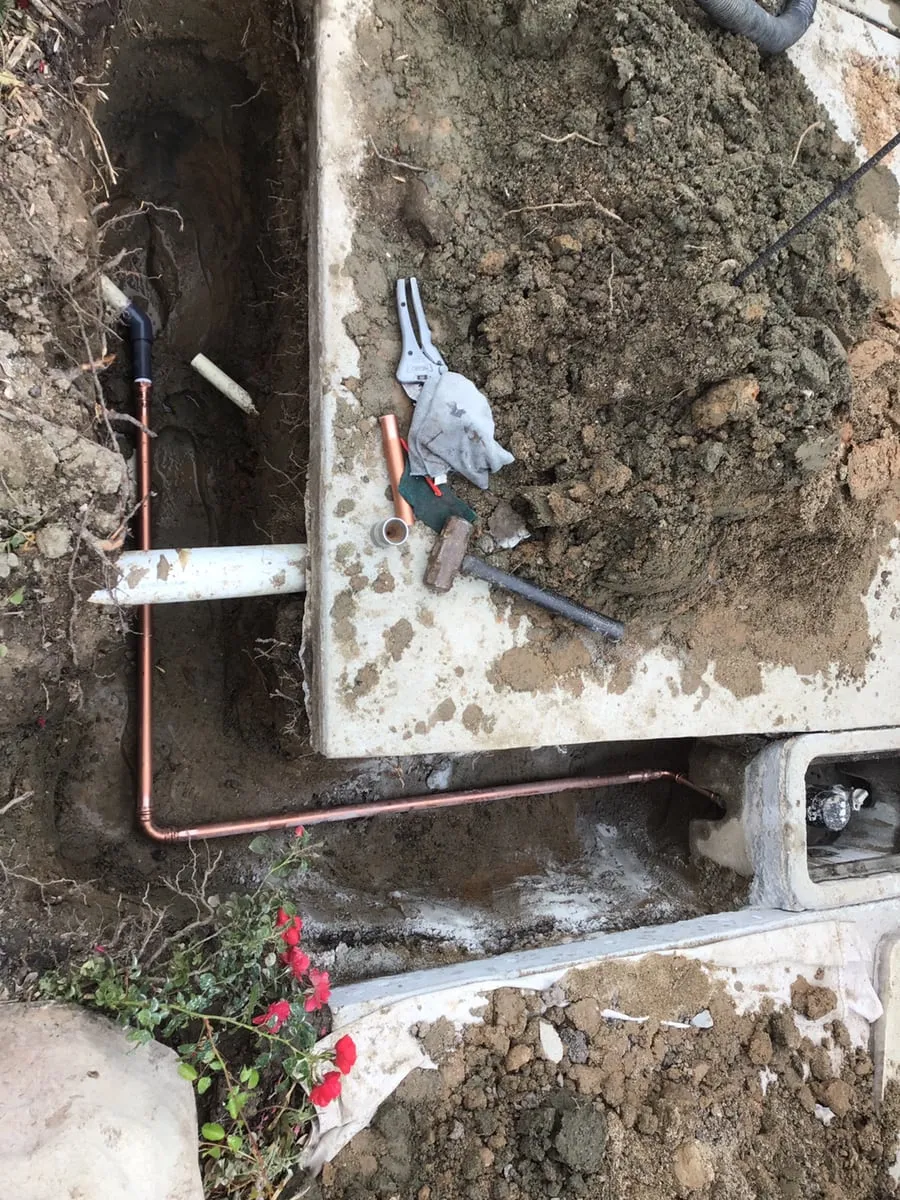
What happens when a line leaks under the slab
In a home built on a concrete slab, some of the water lines can run under or through the floor. When one of them leaks, the water goes into the ground beneath the house and up into whatever sits on the slab. Nothing drips from a ceiling, so a slab leak can run for weeks before anyone notices. The clues are a meter that never stops, a bill that keeps climbing, flooring that lifts or feels damp, and, on the hot side, a floor that feels warm.
Which side is leaking matters twice. A hot line leaking under the floor warms it, which helps find the spot, and it keeps the water heater refilling and reheating for as long as it runs. A cold line gives fewer clues, and the meter is usually what gives it away.
Slab leak detection
Slab leak detection has a narrower job than a search of the whole house: the leak is already known to be under the floor, and the question is exactly where. The meter confirms it first. Shutting off the cold supply to the water heater then shows whether it is on the hot side, and closing off parts of the system one at a time narrows it to a single line. The last step pinpoints the spot from above the floor, usually by listening for water escaping under the slab or by following the warmth of a hot line.
How exact that spot has to be depends on the repair. Repairing at the leak needs the precise location, because the floor is opened right there. A reroute only needs to know which line has failed, since the new line bypasses all of it. Leak detection covers the search in the rest of the house, and the signs that send people looking.
Repairing at the leak
One option is to fix the leak where it is. The flooring over the marked spot comes up, the concrete is broken out over a small area, and the damaged length of pipe is replaced. Once the line holds, the opening is filled and the slab patched, ready for flooring again.
It keeps the house’s plumbing as it was and needs only one opening, which makes it a good fit for a single leak on a line that is otherwise sound. The tradeoffs are the floor work, which is harder under tile, hardwood or cabinets, and the rest of the old line, which stays under the slab at the same age as the part that failed.
Slab leak reroute
The other option, a reroute, leaves the slab alone. A new line is run around the problem, usually up into the attic or through the walls, and connected where the old line fed its fixtures. The leaking line is capped and left in the slab, out of service. The openings it needs are in drywall, which is easier to patch than tile or concrete.
A reroute fits a line that has leaked before, or a leak under flooring that would be costly to lift. When several lines are going, compare the price of a repipe before rerouting them one at a time: a repipe usually takes all the supply lines out of the slab at once.
Repairing at the leak and rerouting compared
| Repair at the leak | Reroute | |
|---|---|---|
| Where the work happens | The floor and slab at the leak | Walls, ceilings or the attic along the new route |
| The old line | Repaired and kept in service | Capped and left in the slab |
| Flooring | Comes up over the leak | Stays where it is |
| Usually suits | One leak on a line that is otherwise sound | A line that has leaked before, or a leak under tile, hardwood or cabinets |
Neither repair stops a different line from failing later. When a house has had leaks on more than one line, the guide to repairing or repiping is where to weigh a repipe against more repairs.
Permits for slab leak repair
The City of Santa Clarita’s building code exempts the repair of a leak itself from a permit, but not the replacement of a concealed water pipe: when one has to be cut out and replaced with new material, the code counts it as new work, which needs a permit and an inspection. Moving water supply piping isn’t an ordinary repair either. Replacing a section of buried pipe and running a new line both need a permit at a city address.
Valencia, Saugus and Canyon Country are founding communities of the city, but each also takes in county land, such as Valencia by FivePoint and the eastern end of Sand Canyon. City addresses get their permits from the city, and county addresses from LA County Public Works at its Santa Clarita Valley office.
The water bill and the insurer
A slab leak can run up a water bill before anyone finds it. SCV Water may adjust the bill once the leak is repaired, if you ask within 60 days of the bill that first showed it and can show proof of the repair; the leak detection page’s high water bill section sets out the rest of its conditions. Keep the invoice and photos of the repair for that, and for your insurer if the leak damaged flooring or walls.
If you think a leak is under your floor, call the shop to have it found and priced.
Sources
6 cited
- City of Santa Clarita, 2025 building code amendments (ordinary repairs, leak repairs and replaced concealed pipe, SCMC 18.02.040), read October 12, 2026
- City of Santa Clarita, city profile (the founding communities), read October 12, 2026
- Supervisor Kathryn Barger, Fifth District areas and LA County, Santa Clarita Valley Area Plan (the county portions of Valencia, Saugus, Canyon Country and Sand Canyon), read October 12, 2026
- SCV Water Resolution SCV-336 (Valencia by FivePoint’s Mission Village is unincorporated county land), read October 12, 2026
- LA County, Santa Clarita Valley Building and Safety Office, read October 12, 2026
- SCV Water, Customer Service Policy, August 2026 (leak adjustments), read October 12, 2026