How hydro jetting works
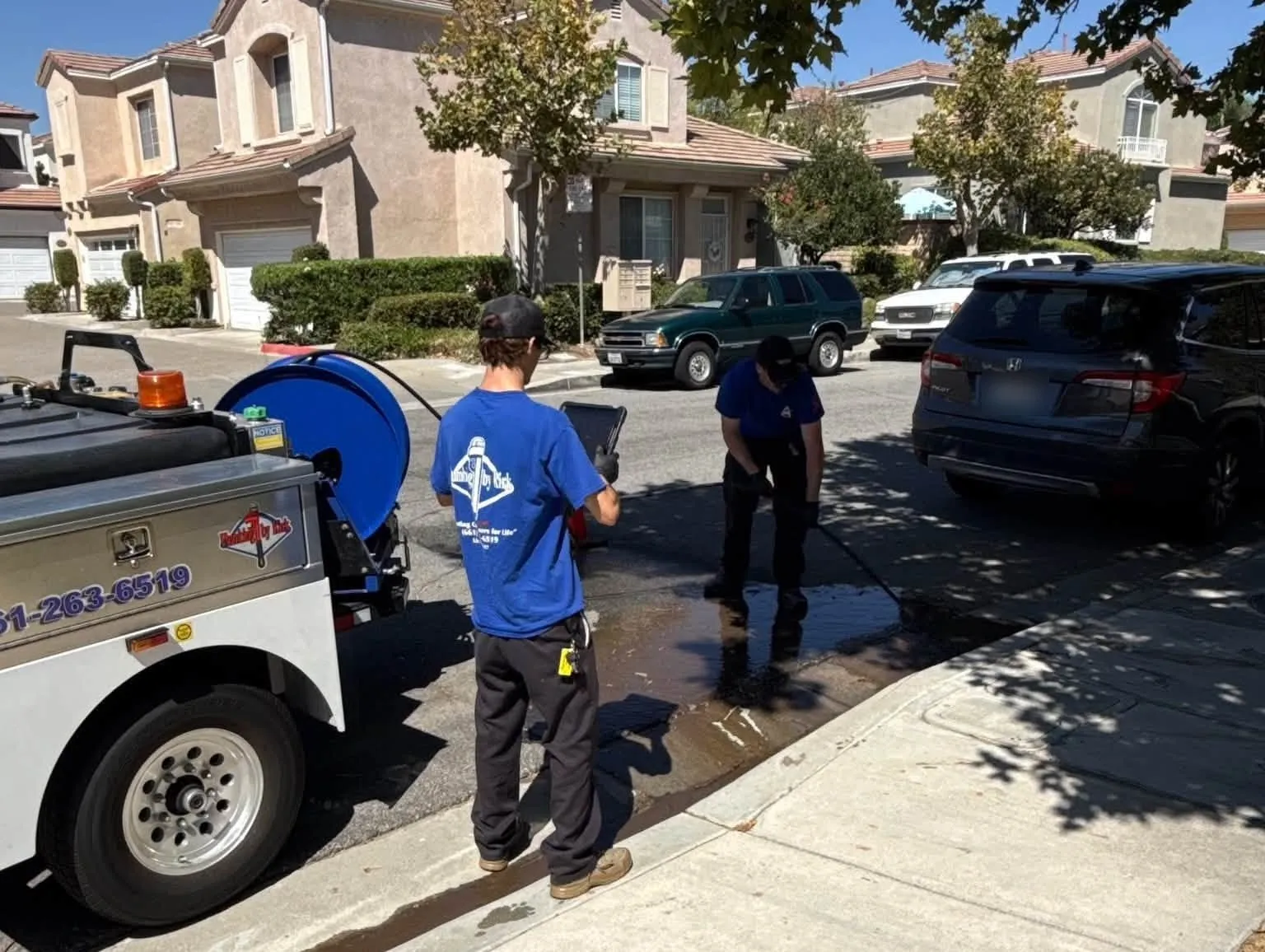
A jetter pumps water through a reinforced hose to a nozzle at its tip. Jets on the nozzle that point backwards drive it up the line, and the spray scours the pipe wall as it goes. What the jets cut loose is flushed down the line toward the public sewer.
Because the water reaches all the way around the pipe, jetting removes buildup rather than poking a hole through it: the grease that lines a kitchen drain, scale on old cast iron, the fine roots that creep in at joints, and the silt that settles in yard drains. That makes it the usual choice for a line that keeps stopping.
Main line clog
A main line clog blocks the one pipe all of the household’s drains run into, so it shows up in more than one place at a time. Water from the washing machine comes up in the shower, a floor drain in the laundry room or garage backs up, or water seeps out around the clean-out cap in the yard.
Many main line clogs come from things jetting deals with. LA Sanitation, which runs the City of Los Angeles sewers, says tree roots and the fats, oils and grease poured down drains cause more than half of sewer backups. Where a line is old cast iron, scale on its walls can add to them. A cable can open the line, but whatever it leaves on the wall gives the next clog something to catch on. That is why sewer hydro jetting is the usual next step for a main line that keeps stopping.
If sewage has already come up into the house, or the line keeps clogging after each cleaning, the pipe itself may be cracked, sagging or broken by roots, and jetting alone won’t fix that. The page on sewer line repair covers what to do about a sewer backup and how a damaged line is repaired.
What happens on a hydro jetting visit
A jetting job starts before any water goes on. A plumber first inspects and evaluates the drain, to understand whether hydro jetting is needed at all; a single slow fixture may only need a cable, which is everyday drain cleaning. Then the right place to feed in the hose, which for a main line is usually the clean-out, is found, and the jetting starts. You hear what the job is and what it costs before that work begins.
A camera inspection answers the questions jetting can’t. It shows whether the line is cracked, has shifted at a joint or sags and holds water, and how much buildup is left on the wall. Those are the difference between a cleaning and a repair.
When jetting isn’t the answer
Jetting cleans a pipe; it doesn’t mend one. If the camera shows a cracked pipe, roots that have forced a joint open, or a collapsed section, jetting may open the line for a while, but the stoppage comes back until that section is repaired. Sewer line repair covers that work, from a single damaged section to a new line.
Fragile pipe calls for care too. An older pipe that has deteriorated can need lower pressure, or the jet can damage it, and badly cracked clay pipe is better cleaned at lower pressure with a narrower nozzle angle. Spotting that is part of what the inspection is for. Whether a cable or the jetter suits an older pipe is the subject of the hydro jetting vs snaking guide.
Routine jetting for lines that keep stopping
Some lines stop on a cycle: a kitchen line that collects grease, or a sewer line that roots find again after every clearing. For those, jetting on a schedule helps keep the line open between problems instead of waiting for the next backup.
Yard and area drains belong on the same list. Leaves, silt and roots collect in the lines that carry rainwater out to the street, and a simple test is to run water into the backyard drain and check that the same amount comes out at the curb. If it doesn’t, the line needs clearing, and jetting is the usual way to do it.
Hydro jetting in Canyon Country, Newhall, Saugus and Valencia
Plumbing by Kirk works from the shop in Valencia and serves the valley. Lines in older homes have had more years to collect grease, scale and roots, and the age of the housing changes a lot from one ZIP code to the next. The Census Bureau’s estimates for 2020 to 2024 show the spread:
| Town | ZIP code | Median year built |
|---|---|---|
| Newhall | 91321 | 1978 |
| Canyon Country | 91351 | 1982 |
| Valencia | 91355 | 1984 |
| Saugus | 91350 | 1989 |
In Newhall’s 91321, 53.8% of homes go back to 1979 or earlier; in Canyon Country’s 91351 it is 44.7%, and in Valencia’s 91355, 36.1%. Saugus is newer, with a fifth of the homes in 91350 (20.3%) built in 2010 or later, but a kitchen line collects grease whatever its age.
Each town has its own page: Canyon Country, Newhall, Saugus and Valencia. When a line keeps stopping, call the shop.
Sources
4 cited
- US Census Bureau, American Community Survey 2020 to 2024, table B25035 (median year built, ZIPs 91321, 91351, 91355 and 91350), read October 12, 2026
- US Census Bureau, American Community Survey 2020 to 2024, table B25034 (homes by year built, the same ZIPs), read October 12, 2026
- LA Sanitation, managing and protecting LA’s sewer system (what causes sewer backups), read October 12, 2026
- NASSCO Tech Tips, flows versus pressures in sewer cleaning (April 2010) and understanding the science of jetting sewers (August 2016) (pressure and nozzles by pipe size, material and condition), read October 12, 2026