What to check first
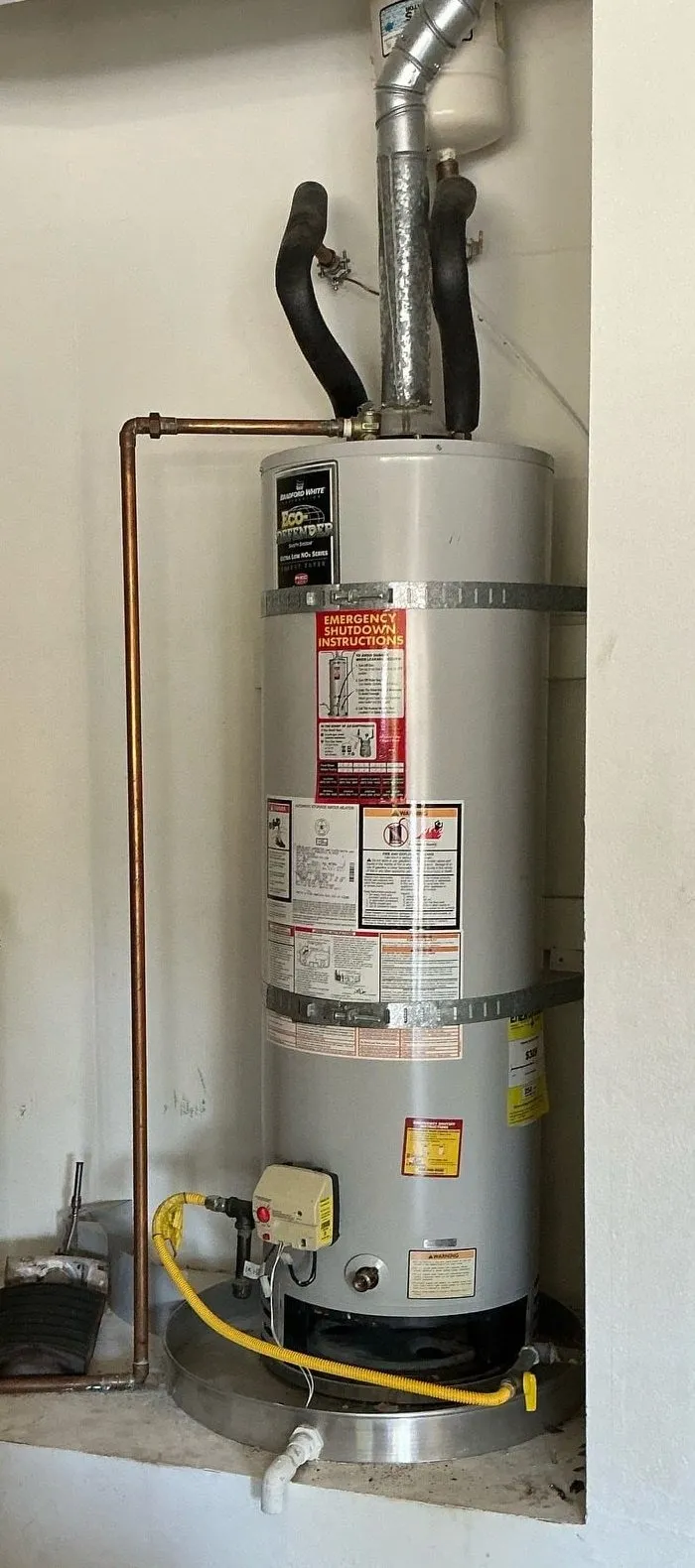
Every hot tap draws from the water heater, so when there is no hot water in your house, the question is whether the heater stopped making heat, or made it and ran out.
If you smell gas at any point, stop here. Get everyone out first, and don’t touch light switches or appliances on the way. Once you are clear of the house, call SoCalGas on 1-800-427-2200. If anyone could be hurt, if property is at risk, or if you can’t get through to SoCalGas, call 911.
Why is my hot water heater not working? Start with these checks, none of which needs a tool:
- How many taps are cold? If every hot tap runs cold, look at the heater. If only one does, the cause is probably in that tap: a worn cartridge or mixing valve, a clogged aerator, or a shut-off valve under the sink that isn’t fully open.
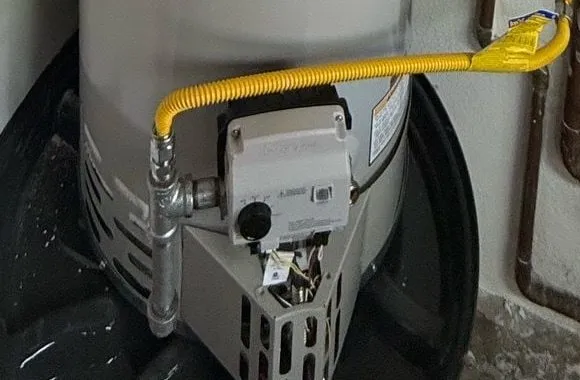
- Which fuel? A gas heater has a gas line running to a control near its base. An electric heater has no gas line, just a power cable.
- On gas, the other gas appliances. If the stove won’t light either, the trouble is probably in the gas supply, not the heater.
- On electric, the breaker. Look for one resting halfway between on and off.
- On a tankless unit, the display. Write down any error code it shows.
Water on the floor, or hot water or steam from the relief valve, is a leak: stay clear of the valve, and follow the water heater leaking guide to make it safe. Soot or scorch marks around the burner door or the vent mean the heater should stay off: turn the gas control knob to off and call the shop.
Gas water heater not working
A gas tank heater makes heat in three steps: a pilot or igniter lights the burner, a sensor proves the flame is there, and the gas control valve opens when the water cools. A fault at any step leaves the burner off, so a gas water heater not working usually comes down to one of those parts or the gas supply.
Water heater pilot light out
On a heater with a standing pilot, the small flame that lights the burner, a water heater pilot light out is the first thing to check. A draft can blow it out, and so can a break in the gas supply. If the heater has a viewing window near the base, look for a small, steady blue flame.
Relight it only by the lighting instructions on the heater’s own label, which differ from one heater to the next. Don’t start if you smell gas, and wait as long as the label says for any gas to clear.
A pilot that won’t stay lit
If the pilot goes out as soon as you let go of the knob, the thermocouple is the usual cause. This small sensor sits in the pilot flame and, while it is hot, keeps the gas valve open; when the flame goes out, it cools and the gas shuts off. A worn one can’t hold the valve open. After two or three tries by the label’s steps, stop and call a plumber.
A pilot that burns for a while and then goes out points to the heater’s air, its vent or its gas: too little combustion air, a clogged vent or an uneven gas supply. Don’t keep relighting a heater with soot or scorch marks around the burner door or the vent. Carbon monoxide has no smell or color, so a detector is worth having in any home with gas appliances.
Electronic ignition and the gas control valve
Some gas heaters light the burner with a spark or a hot surface igniter instead of a standing pilot. Many need household power, and after several failed tries to light, they can lock out to prevent a gas buildup. A heater in lockout, or one with a failed igniter, needs a plumber.
If the pilot stays lit but the burner never comes on, the suspects are a thermostat dial set too low, a weak gas supply or a failed gas control valve. The valve needs precise calibration, so replacing it is a plumber’s job, and it is the costly gas repair that the repair-or-replace question below often turns on. Many newer heaters also shut the gas off if the burner area overheats, from a blocked vent, too little air or flammable vapors, so keep gasoline and paint thinner out of any room with a gas heater.
Electric water heater not heating
Most electric tanks heat with two elements, one high and one low, each with its own thermostat, behind a high-limit switch that cuts the power if the water gets too hot. A tripped breaker, a tripped high-limit switch, a failed element or a failed thermostat are the usual reasons for an electric water heater not heating.
Most household electric heaters run on 240 volts, and the wiring behind the access panels stays live whenever the breaker is on. Switch the heater’s breaker off before any panel comes off. Breaker labels can be wrong, so if you can’t be sure the power is off, leave the panels on and call the shop.
A tripped breaker rests halfway between on and off. Switch it fully off, then firmly on. If it trips again right away, leave it off: something in the heater or its wiring has a fault, often a heating element that has grounded.
The high-limit reset
Behind the upper access panel, the upper thermostat has a red reset button. It is the high-limit switch, which trips when the water gets too hot and cuts the power to the elements until someone presses it. To reset it:
- Switch the breaker off.
- Remove the upper access panel, then the insulation and the plastic cover behind it.
- Press the red button firmly until it clicks, and touch nothing else behind the panel.
- Put the cover, the insulation and the panel back, then switch the breaker on.
If it didn’t click, the switch hadn’t tripped, and an element or a thermostat is the next suspect. If it trips again later, the cause is still there, usually a grounded element or a failed thermostat. Never jump or bypass the switch: it is the heater’s safety cut-out.
Elements and thermostats
No hot water at all points to the upper element or its thermostat; hot water that runs short points to the lower one. Scale can shorten an element’s life, and valley water is hard. Testing them takes a meter, and some checks are made with the power on, so it is the shop’s job.
Tankless water heater with no hot water
A tankless unit heats water only while a hot tap is open: on a gas unit, a flow sensor lights the burner when the water starts to move. So a tankless water heater with no hot water either didn’t start or shut itself down.
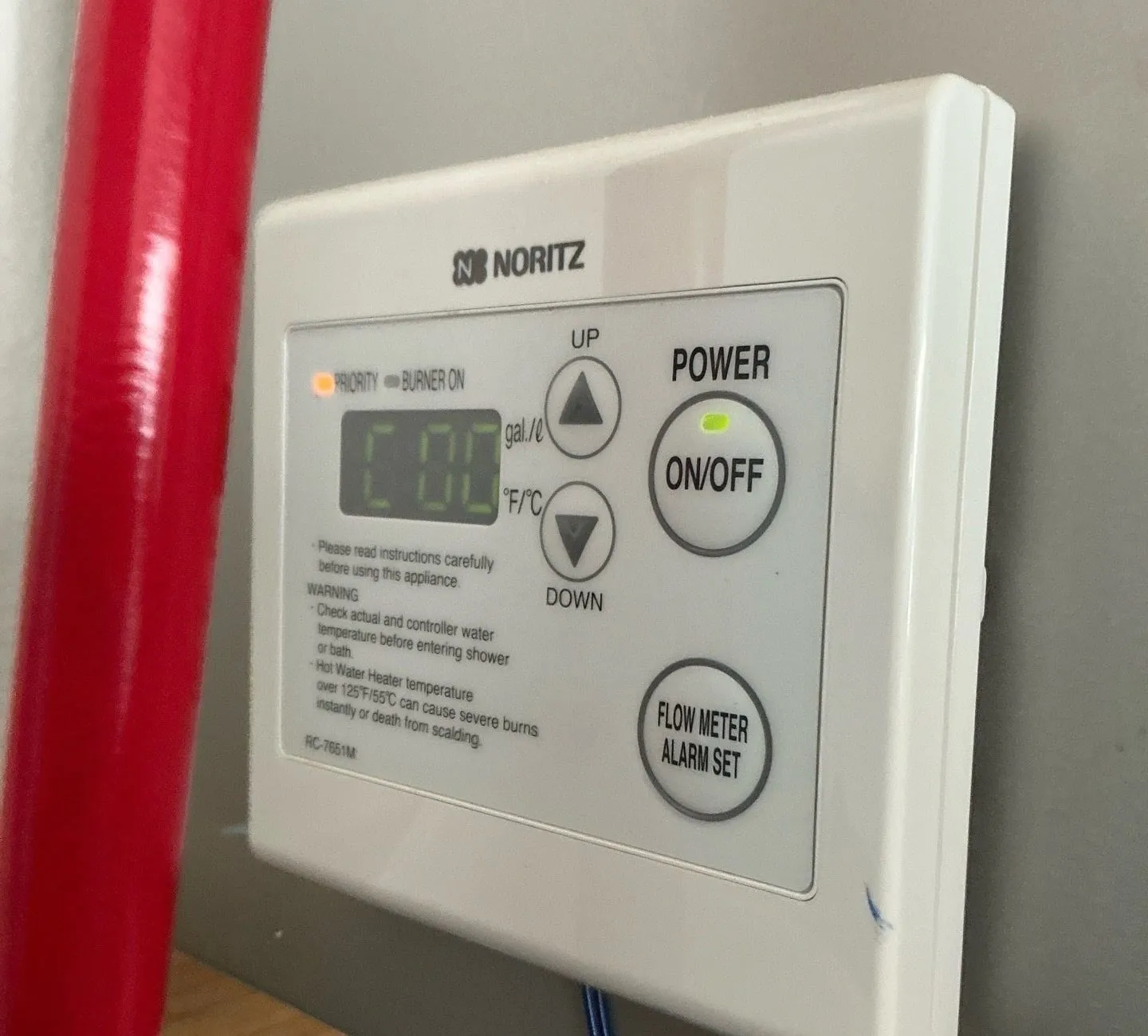
- Read the display. Write down the error code, the make and the model: codes differ from maker to maker, and the manual explains each one.
- Check the valves and the power. The gas and water supply valves should be fully open, and the unit’s breaker on.
- Open the hot tap fully. A tankless unit needs a minimum flow before it fires, about half a gallon a minute on most of one maker’s models, so a tap barely opened, or a very low-flow fixture, may never start it.
- Reset it as the manual says, usually from the control panel.
Scale is the other big cause: minerals coat the heat exchanger and clog the inlet filter, which cuts the flow and can keep the unit from firing or make it shut down. In the valley’s hard water, descaling is a regular job. A code that keeps coming back, an ignition fault or a unit that keeps shutting down is a call to the shop, and tankless water heater repair covers the common faults.
When hot water runs out fast
If your hot water runs out fast, the heater is making heat but not enough of it, or the tank has lost room to hold it. The usual causes:
- Sediment. Heating hard water settles calcium carbonate on the floor of the tank, where it takes up room and, over time, shortens the tank’s life. SCV Water’s 2026 report puts its groundwater’s hardness at 354 mg/L on average, against about 160 for its imported surface water, in a mix that varies across its service area. Rumbling or popping as the tank heats is the usual sign. Flushing through the drain valve usually helps, with the heat off and the water cooled first, because what comes out is hot.
- A failed lower element on an electric heater. The lower element does most of the heating, so the tank still gives some hot water, then runs short.
- A damaged dip tube. The dip tube carries incoming cold water to the bottom of the tank. A cracked or broken one lets the cold water in near the top, so the hot water turns lukewarm early.
- The thermostat setting. A dial set low gives less hot water, but turning it up adds scald risk: the Consumer Product Safety Commission says a setting of 120 degrees Fahrenheit may be necessary to reduce the risk of most tap water scalds.
- A tank too small for the household. More people, or showers and laundry back to back, can outgrow a tank.
Should I repair or replace my water heater?
Three things decide it: the tank, the heater’s age and the part that failed.
| What the visit finds | The usual call |
|---|---|
| Water seeping through the tank wall | Replace, at any age |
| A small part has failed (igniter, thermocouple, element, thermostat or relief valve) on a heater inside its working life | Repair |
| A failed gas control valve, or a second major failure, on a heater at the top of its working life or past it | Ask for the repair and a replacement priced side by side |
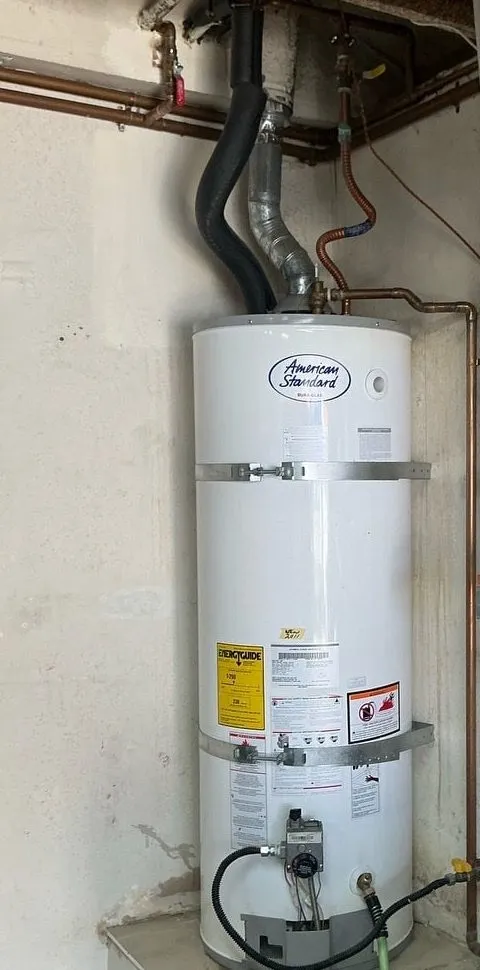
The tank. A tank that leaks through its wall is finished at any age: the steel has corroded through. The leaking guide linked above shows how to tell a tank leak from a fitting or a valve.
The age. The rating label on the side of the heater gives the manufacture date, printed or coded into the serial number. A tank water heater lasts 8 to 12 years on average, and hard water can shorten that. Well short of that age, a failed part is usually worth fixing. Toward the top of the range or past it, a repair buys time on a tank that may fail anyway.
The part. Igniters, thermocouples, elements, thermostats and relief valves are made to be swapped; a gas control valve is the costly one. The part, the fuel, the heater’s age and how easy it is to reach all move the price of a repair.
When to replace a water heater
Plan a replacement when a heater’s age and its signs agree, so you choose the day and the size ahead of time. The signs:
- Hot water that runs out sooner than it used to
- Rumbling or popping as the tank heats
- Rusty or brown water from the hot taps (a corroding tank is one cause, iron in the water another)
- Rust or moisture at the base of the tank
- A heater at the top of its 8 to 12 years, or past it, that needs its second repair
A new heater needs a permit from the office that covers the address. The City of Santa Clarita lists a water heater changeout among its instant online permits for homes, and LA County Public Works says a permit is required for any water heater installed or replaced in the unincorporated areas. California’s Health and Safety Code section 19211 requires every new or replacement water heater to be braced, anchored or strapped against earthquakes.
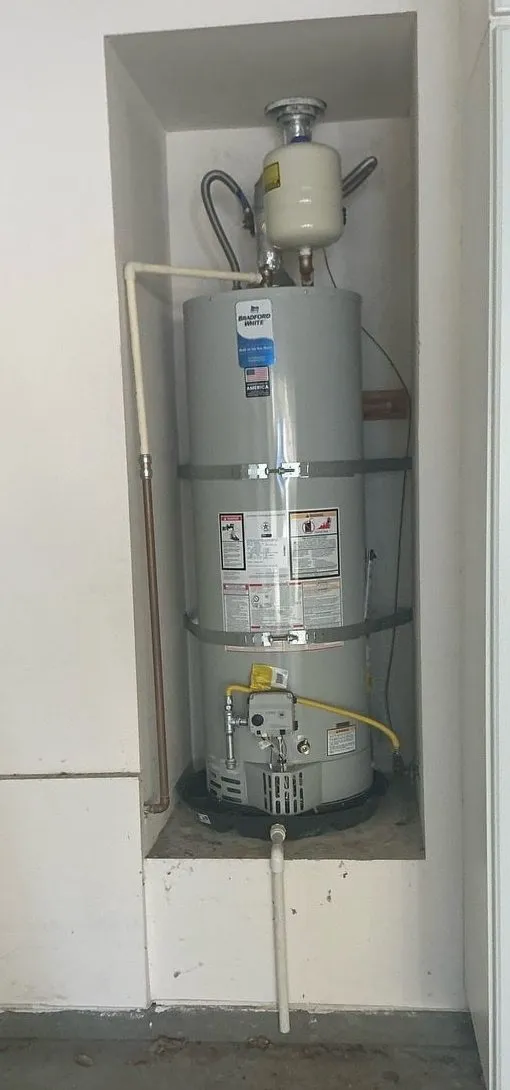
For what the swap involves, from taking the old heater out to the vent and the relief valve line, see water heater replacement. If you are weighing tankless instead, tankless vs tank water heaters compares the two for a valley home.
Getting the hot water back
Call the shop or request service and say the fuel, the heater’s age if you know it, any error code, and what the heater is doing: “the pilot won’t stay lit”, “the breaker trips again” and “it runs out after two showers” each point to a different part. Until then, leave a heater switched off if its breaker keeps tripping or it has locked itself out. Kirk’s crew works on gas and electric tanks and tankless units all over the Santa Clarita Valley, and water heater repair in Santa Clarita lists the repairs the shop makes on each.
Sources
10 cited
- SoCalGas, emergency response and natural gas leaks (leave first, switch nothing on or off, call from a safe place), read November 17, 2026
- National Board of Boiler and Pressure Vessel Inspectors, Residential Water Heater Safety (sediment and the drain valve, the relief valve, the anode rod, carbon monoxide; originally published in 2001), read November 17, 2026
- US Consumer Product Safety Commission, Avoiding Tap Water Scalds (the 120 degree setting) and Flammable Liquids Safety Alert (flammable vapors and gas water heaters), read November 17, 2026
- ENERGY STAR, how whole-home gas tankless water heaters work (the flow sensor that lights the burner), read November 17, 2026
- Water heater makers’ own service manuals and help pages, for gas tanks, electric tanks and tankless units (the pilot and thermocouple, electronic ignition, the high-limit reset button, the dip tube, a tankless unit’s minimum flow and scale), read November 17, 2026
- HomeTips, No Hot Water at One Fixture (a cartridge, mixing valve, aerator or shut-off valve), read November 17, 2026
- SCV Water, 2026 Consumer Confidence Report (hardness), read November 17, 2026
- City of Santa Clarita, instant online permits and LA County Public Works, water heater permit FAQ, read November 17, 2026
- California Health and Safety Code section 19211 (water heater bracing, anchoring or strapping), read November 17, 2026
- The tank life span, about 8 to 12 years on average, is Plumbing by Kirk’s own figure, from the water heater page of the shop’s earlier website, read October 13, 2026.